
| TL;DR: Pennsylvania has no statewide sign permit law. Each municipality issues its own permits under a local zoning ordinance adopted through the PA Municipalities Planning Code. Most exterior signs require a permit. The application typically takes 2 to 8 weeks depending on the municipality and whether revisions are needed. The most common reasons projects stall: incomplete drawings, zoning violations discovered mid-review, and applicants who skip the pre-application step. |
In This Guide
- Why There Is No Single PA Sign Permit Rule
- What Types of Signs Require a Permit
- The Most Permit-Intensive Sign Types
- What a Sign Permit Application Typically Requires
- How Long the Process Actually Takes
- The Real Reasons Projects Stall
- What Happens If You Skip the Permit
- How to Make the Process Go Faster
- Frequently Asked Questions
When a new sign project gets delayed, it is almost never the fabrication that takes the time. It is the permit. And in Pennsylvania, sign permit requirements are set entirely at the municipal level, which means the rules in Cranberry Township are not the rules in Pittsburgh, and neither set matches what applies in Moon Township or Bethel Park. There is no state agency that issues sign permits. There is no single set of Pennsylvania sign permit requirements that applies everywhere.
This causes real problems for businesses that start a project without understanding the process. A sign that is designed, quoted, and ready to fabricate can sit for weeks or months while the municipality reviews a permit application that was incomplete, or while the business owner learns for the first time that their site’s zoning district has restrictions they weren’t aware of.
This guide explains how the system actually works, what triggers a permit, what goes into a typical application, and what to do to avoid the delays we see most often.
Why There Is No Single PA Sign Permit Rule
Pennsylvania sign permitting flows from the Pennsylvania Municipalities Planning Code, commonly called the MPC, which is Act 247 of 1968. The MPC gives municipalities, which in Pennsylvania means cities, boroughs, and townships, the authority to adopt and enforce their own zoning ordinances. Those ordinances govern land use, building standards, and signage. Sign permits are issued by the local municipality, not by any state agency.
What this means in practice: the sign that is perfectly legal at your current location may require a variance at a new location two miles away in a different municipality. Size limits, illumination rules, setback requirements from property lines and rights-of-way, rules about electronic message centers, and even the definition of what constitutes a sign all vary by ordinance.
In our experience working with commercial clients across Allegheny, Butler, and Westmoreland counties, the municipalities that generate the most permit questions from our clients are Pittsburgh, Cranberry Township, Marshall Township, and the Route 19 corridor communities. Each has its own zoning code with its own sign chapter, and each enforces it through its own zoning officer. When a project crosses a municipal boundary, the rules change.
What Types of Signs Require a Permit
Most permanent exterior signs require a permit. The categories that almost always trigger a permit requirement include:
- Wall signs and building signs attached to or painted on the exterior of a structure
- Freestanding signs including monument signs, pylon signs, and post-and-panel signs
- Projecting signs that extend from a wall
- Electronic message centers and digital displays
- Illuminated signs of any type, including cabinet signs and channel letters with internal or external lighting
- Signs over a certain square footage, which varies by municipality but is often as low as 4 to 6 square feet
Signs that typically do not require a permit include temporary window graphics under a specified area (often 25 to 50 percent of window area), portable signs used on private property for a limited period, and most interior signs. That said, these exemptions vary by ordinance. A “temporary” sign left in place for more than 30 days may lose its exempt status under some codes.
If you’re planning any permanent exterior sign for your property, the safest assumption is that a permit is required. Confirming with the municipal zoning office before design is finalized takes about one phone call and saves the most common category of delay.
The Most Permit-Intensive Sign Types
Some sign types generate more permit complexity than others, and knowing this before you design saves time.
Monument signs are the most frequently delayed sign type we handle. They sit in the ground, often near the road, and are therefore subject to setback requirements from property lines and rights-of-way. Municipalities have strict rules about how close a freestanding sign can be to the road edge, and those rules depend on the zoning district. In some cases, the desired location for a monument sign falls within the required setback, which means the applicant either redesigns the sign placement or applies for a variance. Variances add weeks to the timeline and are not guaranteed.

Electronic message centers (EMCs) face the most restrictive treatment in most PA zoning ordinances. Many municipalities limit or prohibit them outright in certain districts. Where they are allowed, there are typically rules about message cycle time (often a minimum of a few seconds per message), brightness limits, and animation restrictions. An EMC that meets federal highway advertising standards may still require local variance approval in a municipality with stricter rules.
Illuminated channel letters and cabinet signs typically require a building permit in addition to the sign permit because they involve electrical work. The building permit triggers an electrical inspection after installation. Skipping this creates code enforcement exposure.
For any of these types, working with a sign company that handles permitting as part of the project is worth the investment. The application process requires precise drawings that match what gets installed, and discrepancies between the approved design and the finished sign are a common source of inspection failures.
What a Sign Permit Application Typically Requires
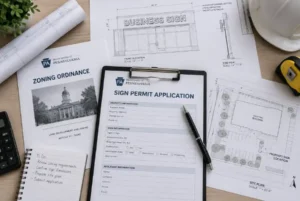
Applications vary by municipality, but a complete sign permit application in most Pennsylvania municipalities includes:
- A completed permit application form, available from the municipal zoning or building office
- A site plan or survey showing the property, the building location, and the proposed sign location with dimensions to the nearest property line and right-of-way
- Elevation drawings of the sign, showing dimensions, materials, letter sizes, and colors
- A specification sheet from the manufacturer for illuminated signs, showing wattage, light source type, and brightness (in nits or candelas for EMCs)
- An electrical permit application if the sign is illuminated (submitted to the building department, often a separate process)
- The permit fee, which is typically calculated on the square footage of the sign face or a flat rate depending on sign type
Some municipalities also require a notarized authorization letter from the property owner if the applicant is a tenant, and a few require photos of the existing site conditions.
The drawing requirement is where most applications run into problems. A rendering from a design program is not a technical drawing. Municipalities want dimensions, material specs, and placement measurements that match what will actually be installed. A sign fabricated to specification and then measured during inspection will fail if the installed dimensions don’t match the approved drawings.
How Long the Process Actually Takes
Timeline depends on the municipality, the completeness of the application, and whether any zoning issues surface during review. In most municipalities we work with in the Pittsburgh metro area:
- A complete, straightforward application in a cooperative municipality: 2 to 4 weeks
- An application that requires a revision: add 2 to 4 weeks per revision cycle
- An application that requires a variance hearing: add 6 to 10 weeks, because variance hearings are scheduled by the zoning hearing board on a set calendar
- Projects in municipalities with high permit volume (Pittsburgh proper): 4 to 8 weeks as a baseline
One thing that surprises business owners: submitting the permit application and ordering the sign materials can happen at the same time. A fabrication job takes 3 to 5 weeks for most commercial signs. If a project is designed correctly and the permit is submitted when fabrication begins, approval often arrives around the time the sign is ready to install. This requires confidence that the design will be approved as submitted, which is why a pre-application review with the zoning office is worth doing on any project with potential complications.
The Real Reasons Projects Stall
Most permit delays are predictable and avoidable. After years of handling permits for commercial sign projects across western PA, the same causes come up repeatedly.
Incomplete applications. The most common cause by far. A missing site plan, a drawing without dimensions, or a manufacturer spec sheet for the wrong product triggers a rejection and restarts the clock. Some municipalities will hold an application pending a correction; others reject it outright and require a new submission.
Zoning violations discovered during review. A business owner designs a sign, gets a quote, and submits a permit application without first confirming the zoning rules for their property. The zoning officer then identifies that the proposed sign is too large for the district, too close to the property line, or a type that isn’t permitted at all. At that point, the project needs to be redesigned, a variance needs to be sought, or the sign type changed.
Property ownership questions. Permit applications are tied to the property, and municipalities require documentation that the applicant has authority to install signage. Tenants who haven’t confirmed sign rights in their lease, or who don’t have a landlord authorization letter ready, lose time chasing that documentation.
Contractor licensing requirements. Some municipalities require that electrical work on illuminated signs be performed by a licensed electrician registered with the municipality, not just any licensed contractor. This requirement, where it exists, isn’t always prominent in the permit application instructions. Discovering it after scheduling installation forces a last-minute subcontractor change.
None of these are unusual problems. They are standard friction points in the permit process that a sign company with local experience knows to check for before the application goes in.
What Happens If You Skip the Permit
Installing a sign without a required permit is a code violation in every Pennsylvania municipality that requires permits. The consequences are more serious than most business owners expect.
Code enforcement officers do site inspections. When a new sign appears without a permit on record, the officer will issue a notice of violation and require the business owner to either obtain a retroactive permit or remove the sign. Retroactive permits are sometimes issued, but they involve an after-the-fact inspection at the installed location, and if the sign doesn’t meet current zoning requirements, removal is the only option regardless of what the sign cost.
Beyond the enforcement risk, an unpermitted sign creates a problem when the property is sold or refinanced. Title searches and commercial real estate due diligence processes often surface unpermitted structures and improvements. An unpermitted sign can complicate a transaction or trigger a remediation requirement as a closing condition.
The cost of a sign permit is a small fraction of the cost of the sign itself. It is worth paying.
How to Make the Process Go Faster
The businesses that move through permitting fastest are the ones that treat it as a design constraint from the beginning, not a paperwork step at the end. In practice, that means:
- Contact the municipal zoning office before finalizing the sign design. Ask what the sign ordinance allows for your property’s zoning district, what setbacks apply to freestanding signs, and whether there are illumination restrictions. This call takes 15 minutes and eliminates the most common causes of design revisions.
- Have complete technical drawings ready when the application goes in. Not a mockup, not a rendering. Dimensioned drawings with material specs and, for illuminated signs, electrical specifications.
- If you’re a tenant, get landlord authorization in writing before starting the permit process. Your sign company will need it and the municipality will require it.
- For complex sign types, ask your sign company whether a pre-application meeting with the zoning officer makes sense. Some municipalities offer this and it can surface issues before they become delays.
- Submit the permit and begin fabrication at the same time on projects where the design is straightforward and zoning compliance is confirmed. This compresses the overall timeline significantly.
| Working on a sign project in western PA? Spark Signs handles permitting as part of the project on exterior sign installations throughout the Pittsburgh region. If you’re planning building signs or a monument sign for your property, we can check the local zoning requirements during the design phase so there are no surprises during review. |
Frequently Asked Questions
Do I need a permit for a business sign in Pennsylvania?
Most permanent exterior signs in Pennsylvania require a permit, but the requirement is set by each municipality’s zoning ordinance, not by the state. There is no statewide sign permit law in Pennsylvania. Contact your local zoning office to confirm what applies to your property’s zoning district before finalizing your sign design.
Who issues sign permits in Pennsylvania?
Sign permits in Pennsylvania are issued by the municipal zoning or building office. Depending on the municipality, this may be a zoning officer, a building code official, or a combined department. There is no state agency involved in standard commercial sign permits.
How long does a sign permit take in Pennsylvania?
A complete, uncomplicated application in most Pittsburgh-area municipalities takes 2 to 4 weeks. Applications that require revisions add 2 to 4 weeks per revision cycle. Projects requiring a variance before the zoning hearing board typically add 6 to 10 weeks on top of the standard review timeline.
How much does a sign permit cost in Pennsylvania?
Permit fees vary by municipality and are typically calculated based on the sign’s square footage or as a flat rate by sign type. In Allegheny County municipalities, fees generally range from $50 to several hundred dollars depending on sign size and type. Some municipalities also charge a separate fee for electrical permits on illuminated signs. Your sign company can confirm the exact fee when preparing the application.
What happens if I put up a sign without a permit in Pennsylvania?
Installing a sign without a required permit is a code violation. The municipality can issue a notice of violation and require either a retroactive permit or removal of the sign. If the sign doesn’t comply with current zoning rules, removal is the only option. Unpermitted signs can also complicate property sales and real estate transactions when they surface during due diligence.
Can my sign company handle the permit for me?
Yes. Most commercial sign companies that do full-service installation handle permitting as part of the project. This includes preparing the required drawings, submitting the application, paying the permit fee on your behalf, and coordinating any required inspections after installation. Confirm this is included in your project scope before signing.