Drive down McKnight Road or Penn Avenue after 8 p.m. and you’ll notice something: half the storefronts disappear into the dark while the other half still command the block. The difference usually isn’t the business, the location, or even the crowd walking by. It’s the sign. A sign that only works in daylight is only doing half its job, because a large share of the traffic passing your building happens after the sun goes down. Business visibility at night isn’t a design afterthought. It’s the reason some storefronts pull in customers at 9 p.m. while the one next door goes unnoticed, even with a better product on the shelf.
What Actually Makes a Storefront Visible After Dark
A storefront stays visible at night when its sign is built with a light source designed into the sign itself, not just a spotlight aimed at it from the parking lot. Internally illuminated signs, meaning channel letters, cabinet signs, and halo-lit dimensional letters, hold their shape, color, and contrast long after ambient daylight is gone. Research from the Sign Research Foundation found internally illuminated signs had 40 to 60 percent longer nighttime recognition and legibility distances than externally illuminated signs, which means drivers and pedestrians can read them from farther away and react sooner. That gap matters most on a fast-moving corridor, where a driver has only a few seconds to notice your building, read the name, and decide to turn in.
Why Nighttime Visibility Is Worth the Investment
An illuminated sign works more like a round-the-clock employee than a one-time expense. A well-lit storefront keeps working long after the register closes: commuters see it every evening on their way home, delivery drivers spot it after a wrong turn, and anyone checking “open now near me” on their phone gets visual confirmation that the address is a real, findable place. The U.S. Small Business Administration has pointed to on-premise signage as one of the most cost-effective forms of advertising available to a business, and the FedEx/Ketchum Signage Study found that 76 percent of consumers have walked into a business they’d never visited before, based on the sign alone. At night, when foot traffic slows and fewer people are actively searching, a glowing sign is often the only marketing a passerby sees.
There’s a safety angle here too, and it’s easy to overlook. A well-lit sign helps drivers and pedestrians identify a building in the dark, which cuts down on confusion at unfamiliar intersections and the awkward last-second lane changes that come from missing a turn.
The Sign Types That Handle Darkness Best
Three sign categories consistently perform best after dark, and each fits a different kind of property.
Channel Letters
Channel letters remain the most common answer to nighttime visibility for Pittsburgh storefronts, and for good reason. These are three-dimensional, individually fabricated letters mounted to the building facade, either front-lit for a bold, even glow across the letter face or halo-lit for a softer outline effect that projects light onto the wall behind the letters. Either option keeps a business name legible from a moving car, which is exactly the audience that matters most after dark. Learn more about channel letter options if you’re weighing front-lit against halo-lit for your storefront.
Cabinet Signs and Lightboxes
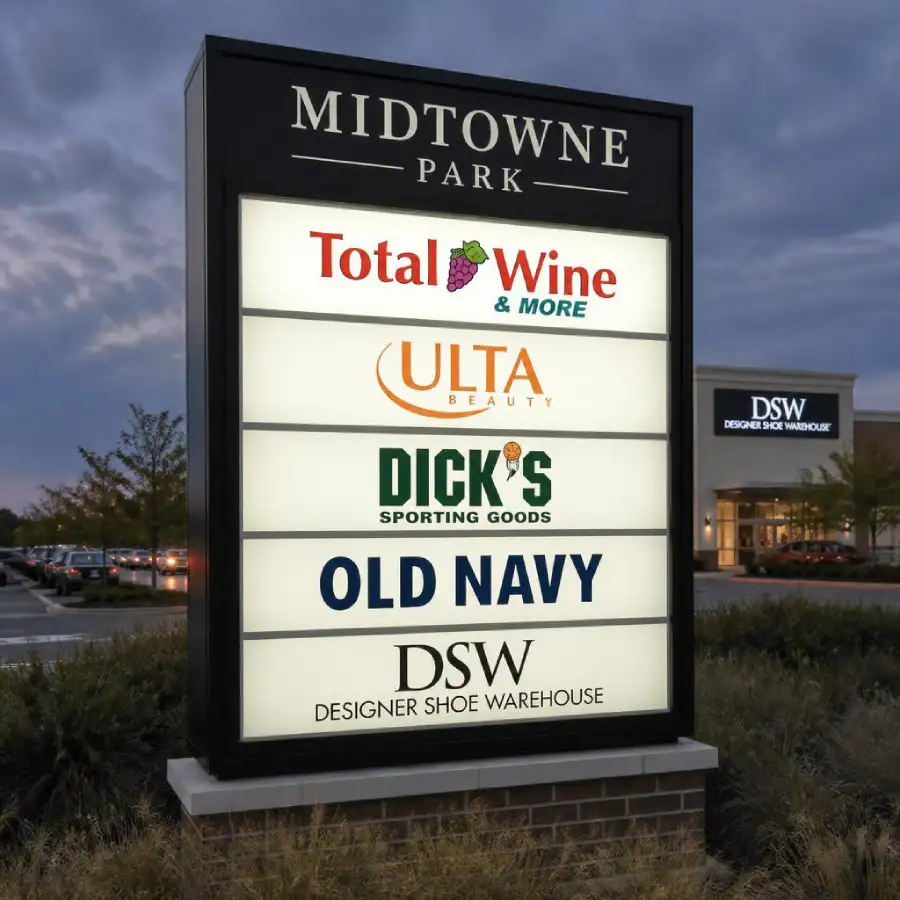
For multi-tenant retail centers, gas stations, and franchise storefronts, cabinet signs and lightboxes do the heavy lifting. These illuminated boxes hold a backlit graphic or translucent vinyl face, and because the whole panel glows evenly, they read clearly from a distance, even in a busy strip mall where several other signs are competing for attention. See cabinet sign options built for tenant panels and standalone storefronts that need to be visible from the road day and night.
Monument Signs
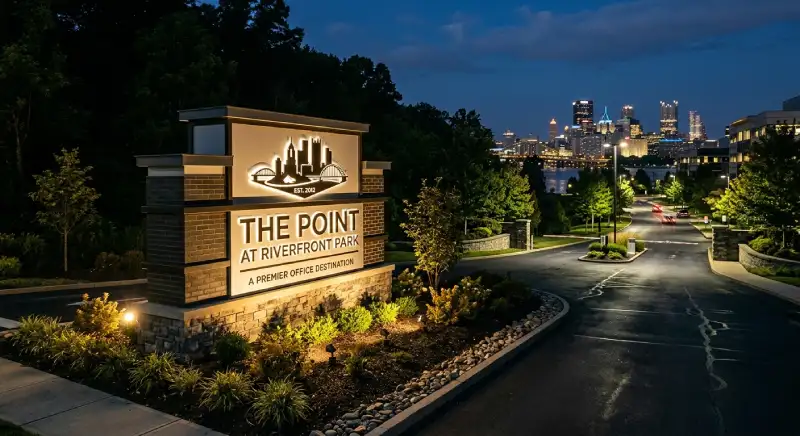
At a property entrance, a monument sign with internal or ground-mounted lighting does double duty: it identifies the address and signals to a driver, at a glance, that they’ve found the right driveway. For office parks, medical campuses, and multi-tenant properties, an unlit monument sign at night is functionally invisible, which defeats its purpose. Explore monument sign options built to hold their visibility once the sun goes down.
Pittsburgh Weather and Nighttime Sign Performance
National advice on nighttime visibility rarely accounts for what Western Pennsylvania actually does to a sign over a full year. Pittsburgh sees real seasonal swings, from summer humidity that can fog cheaper light fixtures to winter ice storms that coat channel letters and monument signs in a layer that blocks the glow entirely. In our experience fabricating and installing signs across Pittsburgh and Allegheny County, the illuminated signs that hold up are the ones built with powder-coated aluminum housings, corrosion-resistant hardware, and LED components rated for the temperature range they’ll actually see, not the mildest-case spec sheet.
Permitting is the other piece that trips up business owners planning a nighttime-visible sign. The City of Pittsburgh Department of Permits, Licenses, and Inspections, along with the individual townships and boroughs across Allegheny, Beaver, Butler, and Washington counties, each set their own rules for illuminated signage, covering everything from allowable brightness to hours of operation for animated or flashing elements. A sign that looks great on paper can still get flagged during inspection if the lighting specification doesn’t match local code. That’s worth confirming before fabrication starts, not after a sign is already mounted on the building.
Choosing the Right Illumination for Your Business
The right approach depends on a few practical factors, not just personal preference. A storefront directly on the sidewalk, on a street like Walnut Street or East Carson Street, benefits from front-lit or halo-lit channel letters, since pedestrians and slow-moving traffic will read the sign from close range. A property set back from the road, like an office park off Route 19 or a shopping center near Cranberry Township, usually needs something taller and brighter: a pylon sign or a monument sign with strong ground-mounted lighting to stay legible at highway speed. Multi-tenant retail centers tend to do best with cabinet signs, since a shared lightbox format keeps every tenant’s panel consistent and evenly lit.
Budget matters too, and it doesn’t always mean starting from scratch. Retrofitting an existing sign with LED components instead of replacing the whole structure can restore nighttime visibility at a fraction of the cost of new fabrication, while still meeting current code. Browse our full range of exterior sign options to compare formats side by side, or request a free on-site consultation and we’ll walk your property and recommend what actually fits your corridor, your building, and your budget.
Frequently Asked Questions About Business Visibility at Night
What is the difference between front-lit and halo-lit channel letters?
Front-lit channel letters light up the entire face of the letter for a bold, even glow, while halo-lit letters project light backward onto the wall behind them for a softer outline effect. Front-lit signs tend to read better from a distance, while halo-lit signs create a premium look often used by law firms, medical offices, and upscale retail.
Do illuminated business signs need a permit in Pittsburgh?
Yes. Illuminated signs in the City of Pittsburgh and most surrounding townships and boroughs require a sign permit that covers brightness, placement, and, for animated or digital elements, hours of operation. Spark Signs handles the permit application process as part of every exterior sign project.
How much does it cost to add lighting to a business sign?
Cost depends on the sign type, size, and whether you’re retrofitting an existing structure or fabricating something new. The most accurate way to get a number is a free on-site consultation, where we evaluate your current sign and recommend options that fit your budget.
Are LED-illuminated signs energy efficient for round-the-clock use?
Yes. LED components use significantly less electricity than older neon or fluorescent sign lighting and typically last longer before needing replacement, which keeps a sign running efficiently even when it’s lit from dusk until dawn every day of the year.
What sign type works best for a business set back from the road?
Properties set back from the street, like office parks or shopping centers off a highway, usually need a pylon sign or a monument sign with strong ground-mounted lighting to stay legible at higher speeds and greater distances than a standard building-mounted sign.
Can an existing sign be retrofitted for better nighttime visibility?
In many cases, yes. Swapping older lighting components for LEDs, adding halo-lighting to existing dimensional letters, or upgrading a cabinet sign’s internal lighting can meaningfully improve nighttime visibility without the cost of a full sign replacement.
Ready to Be Seen After Dark?
If your storefront disappears once the sun goes down, that’s a fixable problem, not a fact of your location. Call Spark Signs at (412) 744-3954 or request a free on-site consultation, and we’ll evaluate your current sign and recommend the illumination that fits your building, your corridor, and Pittsburgh’s weather.