Most business owners only hire a sign company a handful of times, which is exactly why the decision goes wrong so often. You don’t have a feel for what a fair quote looks like, you don’t know which questions matter, and the cheapest bid usually looks fine on paper until the permit gets rejected or the letters start going dark.
How to choose a sign company comes down to five checks: they build or directly manage the type of sign you need, they handle permits in your municipality, their illuminated signs are UL listed, they give you an itemized written quote after a site survey, and they will still service the sign after the warranty ends. Get two or three quotes against the same specs and compare them line by line, not by the total.
Below is the checklist we’d use if we were on your side of the table, a scoring sheet for comparing bids, and the red flags that tend to show up before a sign project goes wrong.
Key Takeaways
- Ask who actually fabricates and installs your sign. Every handoff adds lead time and blurs who owns a problem.
- Permit rules change from one municipality to the next, and Allegheny County alone has 130 of them. Your sign company should know yours.
- Illuminated signs have to be listed (usually to UL 48) under the National Electrical Code, and inspectors check for the label.
- Compare itemized quotes, not totals. Low bids usually hide in missing permit fees or cheaper materials.
- The best predictor of a good experience is how the company answers “who fixes this in year three?”
Why Choosing the Right Sign Company Matters More Than the Price
A permanent building sign usually stays on your facade for years, and it works every hour you’re open plus plenty of hours you’re not. That makes it one of the few marketing purchases where a bad decision stays in public view.
Customers notice. In a September 2026 survey of more than 2,000 U.S. adults, conducted by The Harris Poll for Signarama, 90% said signage affects whether they see a business as professional or high quality, and 41% said they had been unable to find a business because its sign was hard to read.
The price gap between a careful sign company and a careless one is usually small next to the cost of a sign that fails inspection, lets water into its cabinet by the second winter, or has to come down because the anchors were wrong for the masonry. A lot of the repair calls we get start the same way: another company put the sign up, and now something is wrong that should never have been installed that way. Choosing well up front is cheaper than fixing it later, which is why we treat the choice of a full-service sign company in Pittsburgh as a long-term decision, not a one-time purchase.
The 10-Point Checklist for Hiring a Sign Company
Work through these in order. The first four rule companies in or out. The rest help you choose between the ones still standing.
1. They Build Your Type of Sign, or Tell You Exactly Who Does
A sign broker is a company that sells and designs signs but sends fabrication, and sometimes installation, to another shop. Brokers aren’t automatically a bad choice, and some do careful work. The issue is accountability. When a channel letter face cracks or a monument sign shows up a shade off your brand color, you want one company that owns the fix, not three companies trading emails.
Ask it plainly: “Which parts of this job happen in your shop, and which do you send out?” A good answer names the parts. “We fabricate the cabinet and faces here, our crew installs it, and a licensed electrician makes the final connection” is a real answer. “We handle everything,” with no detail behind it, is not.
For transparency, Spark Signs is an independently owned member of Signworld, a national network of sign companies. That gives us shared purchasing and technical resources, while your project is designed, managed and installed by our local team in Western Pennsylvania.
2. They Know the Sign Code Where Your Building Sits
Sign permits are local, and in Western Pennsylvania “local” can mean very local. Allegheny County is divided into 130 municipalities, and a township, a borough and the City of Pittsburgh can each set their own rules for sign size, height, illumination and setbacks. A sign that’s approved on one side of a municipal line can need a variance on the other. We go into the details in our guide to how sign permits work in Pennsylvania.
Ask whether the company pulls the permit, prepares the drawings, and includes permit fees in the quote. Then ask when they last permitted a sign in your municipality. A company that tells you to apply for the permit yourself is usually telling you exterior work isn’t its main business.
If you lease your space, add one more question: have they worked with your landlord’s sign criteria? Shopping centers and office parks often have their own sign rules on top of the municipal code, and landlord approval can take as long as the permit itself.
3. Their Illuminated Signs Are UL Listed
Article 600 of the National Electrical Code requires electric signs to be listed and installed according to that listing. In practice, that usually means a UL 48 label: a mark showing the finished sign was built and tested to the recognized safety standard for electric signs. It’s one of the first things an electrical inspector looks for on lit channel letters or a cabinet sign.
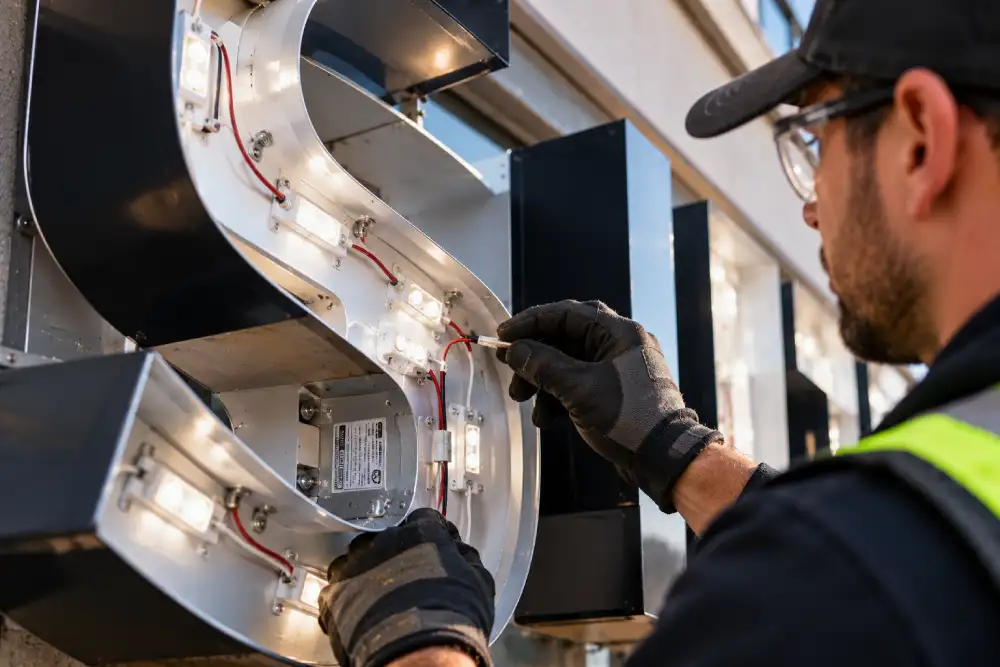
An unlisted lit sign can fail inspection, push back your opening date, and complicate an insurance claim if something electrical goes wrong later. Ask where the label will go on your sign and whether the shop is authorized to apply it. A vague answer here is enough reason to move on.
4. They Use Their Own Installers, Equipment and Insurance
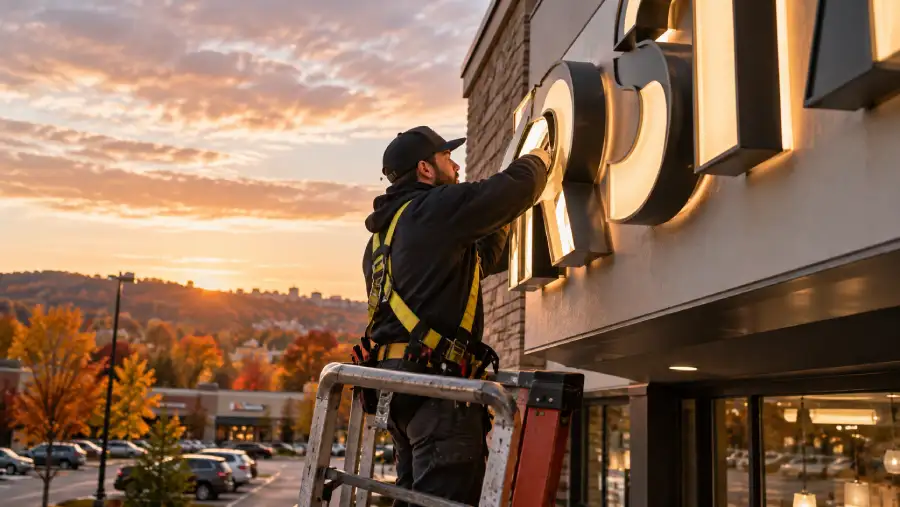
Installation is where good fabrication gets ruined. Mounting a sign to a century-old brick facade is a different job than mounting it to new metal panel, and the installer needs to know which wall they’re drilling into before they start. The same goes for finding the electrical feed, working around awnings, and setting a monument sign footing deep enough to sit through a Pittsburgh winter.
Ask whether the installation crew works for the company or is subcontracted, whether they own the bucket truck or crane the job needs, and request a certificate of insurance naming your business or your landlord. A reputable sign company sends one without a second thought.
5. They Show You Installed Work You Can Go See
Renderings show what a sign could look like. Installed signs show what this company actually builds: straight mounting, clean wiring, sealed edges, faces that haven’t faded. Ask for projects similar to yours in type and size, ideally with addresses or business names, and look through their recent projects if they publish them.
Then drive past one or two signs that have been up for a few years. Weathering is the honest part of any portfolio, especially here, where freeze-thaw cycles find every weak seal and road salt finds every bare edge.
6. They Survey the Site Before Giving a Final Price
A quote built from a phone photo is an estimate of an estimate. For permanent exterior signs, someone should measure the wall, check what it’s made of, locate the electrical supply, and look at sight lines from the road and the parking lot. Those details change the price, and discovering them after the deposit is how change orders happen.
Photos are fine for a first ballpark. We use them ourselves to save clients a trip when a project is simple. But the final number for a building sign should come after someone has stood in front of the building.
7. They Give You an Itemized Written Quote
A one-line quote (“channel letters, installed”) makes comparison impossible. Ask for design, materials, fabrication, permits and fees, electrical work and installation as separate lines, along with the materials spec: aluminum or PVC returns, the LED and power supply brand, the face material, and the mounting method.
This is usually where a low bid gets its low price. One quote includes the permit and the next quietly leaves it out. One uses aluminum and the other uses a material that won’t hold up as long outdoors. You only see the difference when the lines sit side by side.
8. They Show You Real Mockups, and You Own the Files
Before anything gets fabricated, you should approve a design mockup: a scaled drawing of the sign placed on a photo of your actual building, with dimensions, colors and materials called out. It’s the cheapest point in the project to catch a problem, like a logo that can’t be read from the road or letters that crowd a window.
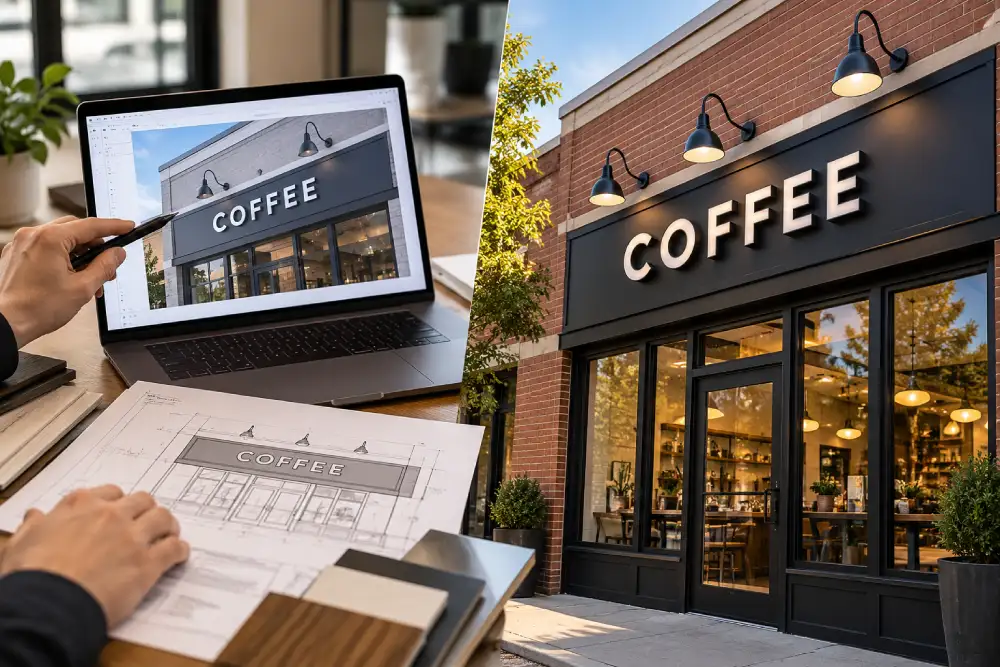
Ask, too, whether you’ll receive the production artwork when the job is done. Some companies include it and some charge a release fee. Owning the files makes reorders, additional locations and future rebrands much easier.
9. They Have a Written Warranty and a Good Answer to “Who Fixes This in Year Three?”
Warranties vary a lot: parts only or parts and labor, one year or several, LEDs covered differently from the structure. Get yours in writing. The more telling question, though, is what happens once the warranty runs out. LED modules dim, power supplies fail, and a few winters of ice and salt are hard on anything bolted to the outside of a building.
A company that runs its own service calls and keeps records of what it installed can usually diagnose a problem faster, because it already knows what’s inside the sign. A company that only sells signs will send you looking for someone else. Our fall sign maintenance checklist shows what that ongoing care looks like in practice.
10. They Give You a Clear Timeline and Answer the Phone
Ask for a written timeline that separates design, permitting, fabrication and installation, and ask which of those stages the company controls. Permitting is often the longest and least predictable step, so a company that promises a firm install date before the permit is approved is guessing.
Pay attention to how fast they respond while you’re still a prospect. It’s the best preview you’ll get of how they communicate once they have your deposit. We commit to responding to quote requests within one business day, and any sign company you hire should be able to make a similar promise.
How to Compare Sign Company Quotes: A Scoring Checklist
Send every company the same information: sign type, approximate size, the building address, photos of the wall, whether the sign is lit, and your deadline. Then score each bid with the sheet below. Weighting the first four items more heavily keeps a low price from hiding a missing permit or an unlisted sign.
| What to check | A strong answer looks like | Weight | Co. A | Co. B | Co. |
|---|---|---|---|---|---|
| C | |||||
| Fabrication and installation | Names what’s done in-house and who handles the rest | ×2 | |||
| Local permit experience | Pulls the permit, includes fees, has worked in your municipality | ×2 | |||
| UL listing (lit signs) | UL 48 label applied by an authorized shop | ×2 | |||
| Site survey | Measures on site before the final price | ×2 | |||
| Itemized quote | Separate lines for design, materials, permits, electrical and installation | ×1 | |||
| Portfolio | Similar installed projects you can go see | ×1 | |||
| Mockups and files | Scaled mockup on your building; you receive the artwork | ×1 | |||
| Warranty and service | Written warranty; runs its own service calls | ×1 | |||
| Timeline and communication | Written schedule by stage; replies within a day or two | ×1 |
How to score: Score each company from 1 to 3
on every criterion. Multiply each score by its weight, then
add the weighted scores. The highest score won’t always be
the cheapest bid, and that’s the point of doing it this way.
Score each company from 1 to 3 on every line, multiply by the weight, and add it up. The highest score won’t always be the cheapest bid, and that’s the point of doing it this way.
Red Flags When Hiring a Sign Company
Any one of these deserves a follow-up question. Two or three together usually mean you should keep looking.
- A firm price for a permanent lit sign without anyone visiting the site.
- “You’ll need to get the permit yourself.”
- No UL label, or vague answers about who handles the electrical work.
- A large deposit requested before there’s a written scope and timeline.
- A portfolio made up of renderings and stock photos rather than installed signs.
- Pressure to sign today because the price “goes up at the end of the week.”
When an Online Sign Store Is the Better Choice
Not every sign needs a local fabricator. For yard signs, simple banners, decals and other items you can put up yourself, an online print shop can be the faster and cheaper option, and we’d tell you so. Once a sign needs a permit, an electrician or a ladder against your building, though, local accountability starts to matter more than the price per square foot. That’s also when it helps to have a company within driving distance when the sign needs attention.
What Working With Spark Signs Looks Like
If you’re comparing sign companies in the Pittsburgh area, here’s how a project runs with us, so you can hold us to the same checklist. It starts with a consultation call, then a site survey when the job calls for one, a free written estimate, and a project timeline. You approve design mockups, we handle permitting where it’s required, and our team fabricates and installs the sign.
We’re based in Mars, PA and work across Allegheny County and Western Pennsylvania, from storefront exterior signs and lit channel letters to monument signs for office parks and medical campuses. You can read more about how our sign process works, step by step.
Frequently Asked Questions
What should I look for in a sign company?
Look for a company that builds or directly manages your type of sign, handles permits in your municipality, uses UL-listed construction for illuminated signs, and gives you an itemized quote after a site survey. After that, compare portfolios of installed work, warranty terms, and whether they provide service once the sign is up.
How many quotes should I get for a business sign?
Two or three quotes are usually enough. More than that tends to add time without adding clarity. What matters more is that every company quotes the same specs, so you can compare materials, permits and installation line by line.
Do sign companies handle permits?
Most full-service sign companies prepare the drawings, submit the application and coordinate inspections, but not all of them do. Ask whether the permit and its fees are included in the quote. In Pennsylvania, sign rules are set municipality by municipality, so experience with your specific township, borough or city matters.
How long does it take to get a business sign made and installed?
It depends mostly on the sign type and the permit. Banners and printed signs can be ready in days, while permitted, illuminated building signs usually take several weeks from approved design to installation. Permitting and landlord approval are often the longest stages, so start early if you have an opening date.
How much does a business sign cost?
The cost depends on size, materials, illumination, installation conditions and permit fees, so a printed panel and a lit monument sign aren’t in the same price range. The only reliable number comes from a site survey and an itemized quote. Spark Signs provides free estimates for businesses in the Pittsburgh area.
Is a local sign company better than an online sign store?
For permanent, permitted or illuminated signs, a local sign company is usually the better choice because it can survey the site, manage the permit, install the sign and service it later. For simple items you install yourself, like yard signs or banners, an online store can be cheaper and faster.
Choose the Company You’ll Still Want to Call in Five Years
The sign is the part everyone sees. The company behind it is the part you deal with when something needs a permit revision, a new face, or a service call on a January night. Run each company through the checklist, score the bids honestly, and pick the one that gives you straight answers.
If you’d like Spark Signs to be one of the quotes on your list, request a free estimate and we’ll get back to you within one business day.