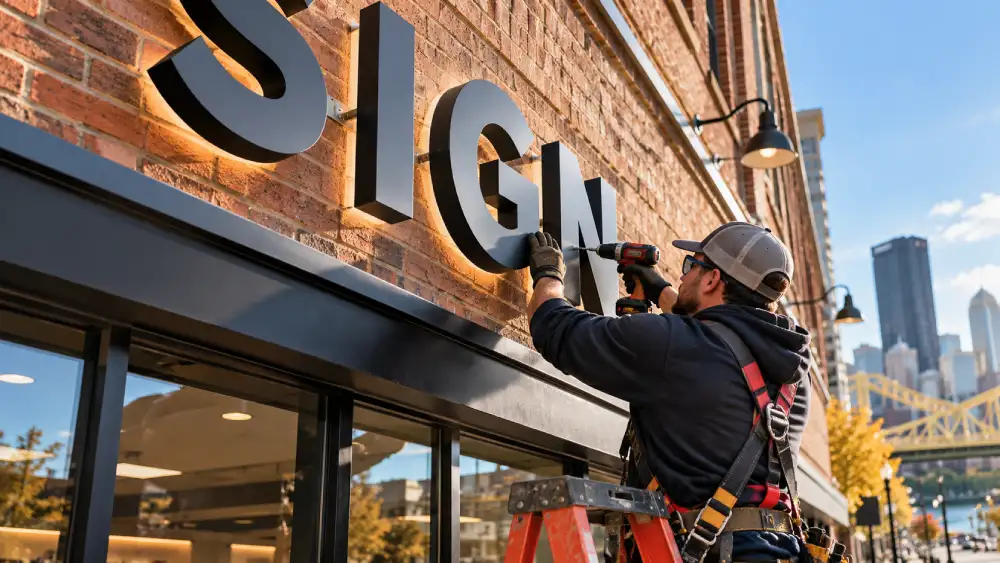
You have one big wall behind the reception desk and a budget that covers one statement piece. Should it be a dimensional logo sign or a floor-to-ceiling mural? Most office managers we talk to in Pittsburgh ask some version of that question, and the honest answer is that the wall usually decides for you.
Here is the short version. A lobby sign is a dimensional logo or name display, usually acrylic, metal, or PVC, mounted on the wall so visitors know exactly whose office they walked into. A wall mural is a large printed or painted graphic that covers most or all of a wall to set a mood or tell a story. Choose a lobby sign when brand recognition is the goal and the wall is small or medium. Choose a mural when the wall is large, plain, and you want the room itself to feel like your brand. When you have the wall and the budget, combine them.
What Is a Lobby Sign?
Lobby signage is the branded sign in a reception or entry area that identifies the business, most often a logo and company name mounted on the main wall a visitor sees first. It is the interior cousin of the sign on your building, and it does the same basic job: confirm that people are in the right place and show them the brand at its best.
Most lobby signs fall into a few construction types:
- Dimensional letters and logos cut from acrylic, aluminum, PVC, or foam, mounted flush or on standoffs so they cast a shadow line.
- Acrylic panel signs with the logo printed or applied to a clear or frosted panel, held off the wall with metal standoffs.
- Metal finishes such as brushed aluminum or brass laminate for law firms, banks, and other clients who want a formal look.
- Lighted signs with backlit or halo-lit letters for lobbies with low ambient light or after-hours visibility through glass doors.
On our custom lobby signs page we break down how acrylic, aluminum, PVC, and dimensional foam compare. The short version: acrylic reads modern, aluminum reads established, and foam lets you go big on a tighter budget.
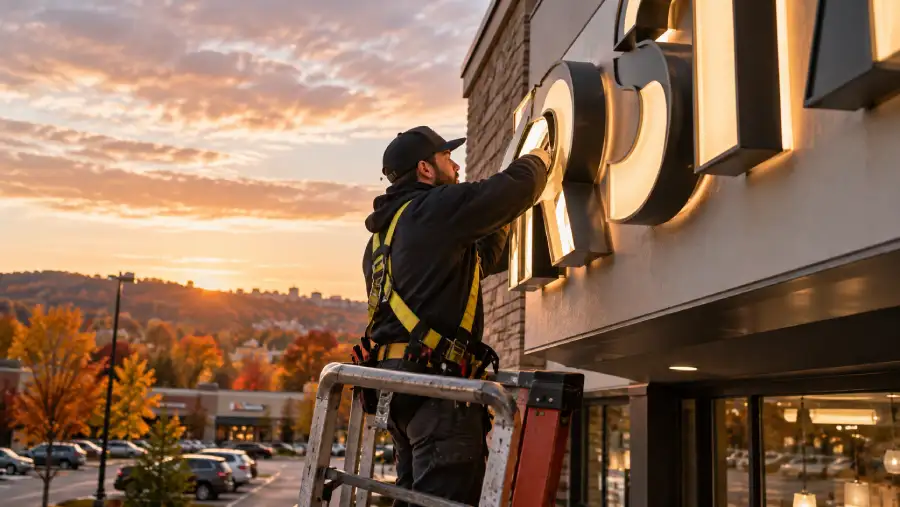
What a lobby sign does well is precision. A crisp logo at eye level, lit properly, makes a small reception area look like it belongs to a serious company. It also travels. When a lease ends, a dimensional sign comes off the wall and goes up in the next office.
What Is a Wall Mural?

A wall mural in a commercial setting is a large-format graphic that covers most or all of a wall, either printed on vinyl or wallcovering material and installed in panels, or hand-painted by an artist. People also call them wall wraps, wall graphics, or environmental graphics.
Commercial murals usually take one of these forms:
- Printed vinyl murals applied directly to the wall. This is the most common choice for offices because it is fast to install and easy to replace.
- Commercial wallcovering (Type II material) for high-traffic areas where scuffing is a concern.
- Textured or specialty vinyl designed to conform to brick, block, or uneven plaster.
- Hand-painted murals for one-of-a-kind artwork, usually with a longer timeline.
- Dimensional murals that combine printed backgrounds with cut letters or shapes mounted on top.
A mural works at a different scale than a sign. Instead of putting one mark on the wall, it changes the whole surface. A plain drywall corridor becomes a photo of the Pittsburgh skyline, a timeline of your company history, or a pattern pulled from your brand colors. Our wall graphics and murals team designs these around the actual dimensions of the space, including outlets, door frames, and thermostats that a stock image never accounts for.
The tradeoff is that a mural is tied to the wall. Vinyl murals can be removed, but they are not reused. If you are in a short lease, that matters.
Lobby Sign vs. Wall Mural: Side-by-Side Comparison
| Factor | Lobby sign | Wall mural |
| Main job | Brand identification | Atmosphere and storytelling |
| Best wall size | Small to medium, or a focal section of a large wall | Medium to very large, full walls |
| Viewing distance | Works up close and across a room | Needs room to step back from |
| Relocation | Can be removed and reinstalled | Usually replaced, not reused |
| Rebrand flexibility | Replace the sign only | Reprint the full graphic |
| Durability | Very high; acrylic and metal last many years | Good with laminated commercial vinyl; edges and corners wear first |
| Install disruption | A few hours, often after hours | Half a day to a full day per wall, depending on size |
| Landlord approval | Usually needed for drilling | Usually needed; removable vinyl is easier to approve |
| ADA relevance | Lobby branding is not an ADA sign, but room ID signs nearby are | Not an ADA sign; keep murals clear of required tactile signs |
If you remember one row, make it the relocation row. It is the one most people forget to ask about.
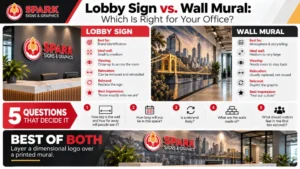
Five Questions That Decide It
Comparison tables are useful, but in our experience the decision comes down to five practical questions. Answer them in order and the right choice is usually obvious.
1. How big is the wall, and how far away will people see it?
A 6-foot-wide wall behind a reception desk is sign territory. A mural on a wall that size often reads as busy wallpaper. A 30-foot wall facing the elevator is the opposite: a lobby sign alone can look lost on it, and that is where a mural pays off.
Viewing distance matters as much as square footage. If visitors see the wall from 40 feet away as they come off the elevator, a mural or a large dimensional logo will register. If the first view is from three feet away while someone signs in, fine detail in a mural is wasted and a clean, well-lit sign does more.
2. How long will you be in this space?
This is the question that gets skipped. If you own the building or have a long lease, a mural is a fair investment. If your lease is up in two years, a lobby sign is easier to justify because it moves with you. A dimensional sign can be taken down at the old office and reinstalled at the new one with fresh mounting hardware. That cannot be done with a vinyl mural.
3. Is a rebrand likely in the next few years?
If your company is growing, merging, or reworking its logo, a mural with the logo printed into the artwork becomes outdated the day the new brand launches. One fix is to keep the mural free of logos and taglines, using brand colors, patterns, or photography instead, and put the logo on a separate dimensional sign. When the brand changes, you replace only the sign.
4. What are the walls made of?
Pittsburgh has plenty of offices in converted warehouses, mill buildings, and older downtown properties. Exposed brick, painted block, and old plaster are full of character, but they change the plan. Standard vinyl will not grip mortar lines properly, so murals on brick need textured-surface vinyl and heat installation, or a painted mural. Dimensional signs on brick need the right anchors and sometimes a backer panel. Drywall in a newer suburban office park is the easiest surface for both.
5. What should a visitor feel in the first ten seconds?
If the answer is “they know exactly who we are,” lean toward a lobby sign. If the answer is “they feel the culture of the place,” lean toward a mural. Law firms, financial advisors, and medical practices usually land on the first answer. Creative agencies, tech companies, gyms, and schools often land on the second.
When to Combine Both
The strongest lobbies we install often use both, layered on the same wall. A printed mural covers the wall with color, texture, or an image, and a dimensional logo sits on top of it on standoffs. The mural gives the room presence and the sign gives it a focal point.
This combination also solves the rebrand problem from question three. Because the logo is a separate physical piece, it can be swapped without reprinting the background.
A few guidelines when layering:
- Keep the mural quiet where the logo goes. A busy photo behind a logo makes both harder to read. Plan a calmer area of the artwork, such as sky, a solid band, or a soft gradient, where the sign will mount.
- Contrast the materials. A matte mural with a brushed metal or glossy acrylic logo creates depth. Two matte surfaces in similar colors flatten out.
- Light the sign, not the whole wall. A wall washer that hits a glossy laminate can create glare across the mural. Directional lighting on the logo avoids that.
- Coordinate the brand colors across both. Color choice carries more weight than people expect, which we cover in our post on the psychology of color in business branding.
For a full interior program that also includes wayfinding, ADA room signs, and glass graphics, see our interior signs overview.
Cost Factors for Each Option
We will not quote a single price here, because both products vary too much by size and materials for a fair average. What we can tell you is what moves the price.
Lobby sign cost depends on:
- Overall size and the number of separate letters or pieces
- Material (foam and PVC are usually less expensive than acrylic, and acrylic less than metal finishes)
- Built-in lighting, which adds electrical work and components
- Mounting method and wall type
- Whether installation happens after hours in an occupied building
Wall mural cost depends on:
- Square footage of the wall
- Material grade (standard vinyl, textured-wall vinyl, or commercial wallcovering)
- Lamination for scuff resistance
- Custom design time versus supplied artwork
- Wall prep, such as patching and priming, before install
A rough planning rule: on a small wall, a lobby sign and a mural can land in a similar range. As the wall gets bigger, mural cost scales with square footage while a sign can stay the same size, so the gap widens. For an accurate number on your space, a site measurement is the only reliable starting point.
Why spend on this at all? A national FedEx Office survey conducted with Ketchum Global Research found that 68% of consumers believe a business’s signage reflects the quality of its products or services. That research focused on signage broadly, but the same judgment happens in a lobby. Visitors notice a peeling decal or a cheap logo panel, and they connect it to the business.
Mistakes We See in Pittsburgh Offices
After years of interior installs across Western Pennsylvania, these are the problems we are called in to fix most often.
Low-resolution mural art. A photo that looks sharp on a laptop can turn soft and pixelated at 12 feet wide. Mural files need to be built at final print size, or close to it, from the start.
A logo that is too small for the wall. A 24-inch logo centered on a 20-foot wall looks like an afterthought. Scale the sign to the wall, or use a mural to fill the space around it.
Ignoring what sits in front of the wall. Reception desks, plants, and TV screens cover more of the wall than people expect. We mock up the design over a photo of the actual space so nothing important lands behind a monitor.
Forgetting the landlord. Most commercial leases require approval before drilling or applying anything to walls. Getting that approval early avoids a delayed install date.
Putting the brand into the mural and then rebranding. This is the most expensive mistake on the list, and the easiest to avoid with the layered approach above.
If you are planning a lobby for a healthcare practice, our post on branding a medical office from reception to exam room covers the extra considerations for patient-facing spaces.
Frequently Asked Questions
What does lobby signage mean?
Lobby signage is the branded sign in a building’s reception or entry area, usually a company logo and name mounted on the main wall visitors see when they walk in. It is typically made from acrylic, metal, PVC, or foam, and it may be lit.
Are wall murals outdated for offices?
No. Printed wall murals are still a common choice for offices, especially in open floor plans, hallways, and break rooms. What has changed is the style: many companies now favor brand colors, local photography, or abstract patterns over literal slogans, which keeps the mural from looking dated as quickly.
What do you call a wall mural in a commercial space?
In commercial projects a wall mural is often called a wall wrap, wall graphic, or environmental graphic. The terms overlap, but “environmental graphics” usually refers to a full interior program that includes murals, window graphics, and wayfinding together.
Which costs more, a lobby sign or a wall mural?
It depends on the wall. On small walls the two can cost about the same, but on large walls a mural usually costs more because pricing scales with square footage. Lighted or metal lobby signs can cost more than a mural on a medium wall.
Can you put a lobby sign on top of a wall mural?
Yes, and it is one of the most effective lobby designs. The mural is installed first, then a dimensional logo is mounted on top with standoffs. Plan a calm area in the mural artwork where the sign will sit so the logo stays easy to read.
How long does each one take to install?
Most custom lobby signs take about two to four weeks from approved design to installation, and the install itself often takes only a few hours. A vinyl mural install usually takes from half a day to a full day per wall, with production time beforehand depending on size and design.
Choosing the Right Statement Piece for Your Lobby
If your wall is small, your lease is short, or brand recognition is the priority, start with a lobby sign. If the wall is large and plain and you want the space to carry your culture, a mural earns its place. If you have the room and budget, layer a dimensional logo over a mural and you get both.
Not sure which fits your space? Send us a photo of the wall and its rough dimensions, and our team in Mars, PA can suggest what will work before you commit. You can also browse more ideas on the Spark Signs blog.