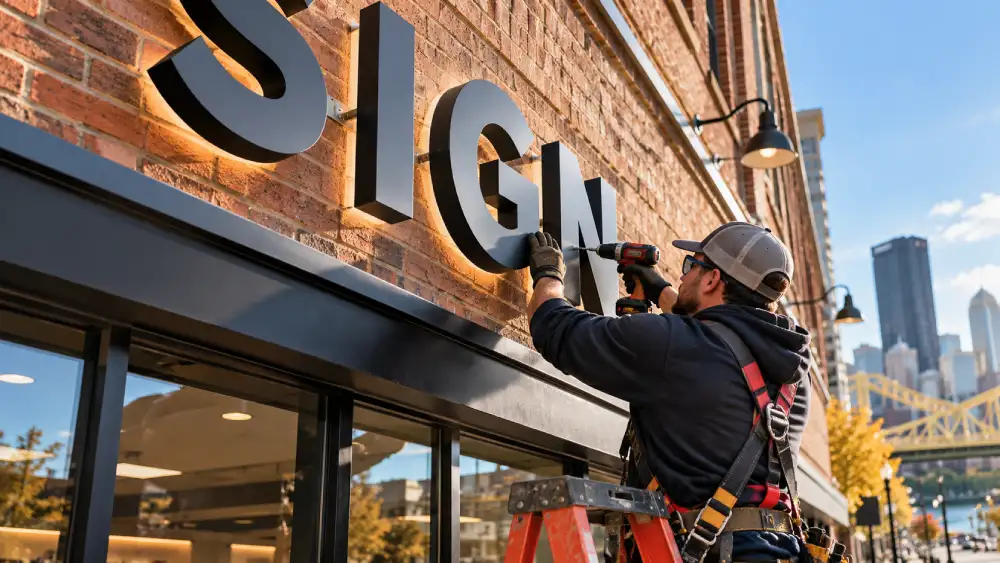
Late in the year, a lot of business owners land on the same question: there’s money left in the budget, the storefront sign has looked tired for a while, so can a new one go up before December 31? Sometimes the answer is yes. Sometimes the calendar simply won’t allow it, and it’s far better to know that in early November than in the third week of December.
Here’s the short version. If you want a new sign to count toward this year’s budget, or toward a possible Section 179 deduction, it generally has to be installed and ready to use by December 31. Ordering it or paying a deposit isn’t enough. Window graphics, interior lobby signs, and vehicle wraps can often make that window from a mid-November order. Large lighted exterior signs that need a permit usually can’t, unless the design and permit work is already underway.
Key takeaways
- The IRS ties Section 179 to the year property is “placed in service,” meaning ready and available for its intended use. For a sign, that usually means installed and working.
- Many types of business signage are treated as tangible business property, but how a specific sign is classified is a question for your accountant.
- Projects with no permit (window graphics, interior signs, vehicle wraps) are the realistic year-end candidates.
- Permitted exterior signs are better started now and installed in spring, with design and permits finished over the winter.
- This article is general information, not tax advice.
Can Business Signs Qualify for Section 179?
Section 179 is a part of the federal tax code that lets a business deduct the cost of qualifying equipment and other tangible business property in the year it’s placed in service, instead of depreciating that cost over several years. That’s why it comes up so often in Q4 equipment conversations.
Sign manufacturers and sign companies commonly describe business signage as qualifying property, and many types of signs are treated as tangible personal property used in a business. The catch is that signage isn’t one category. A vehicle wrap, a digital message center, a set of channel letters bolted to a facade, and a concrete monument sign with a buried foundation are very different things, and they may not all be classified the same way.
Publication 946 explains that buildings and their structural components generally fall outside standard Section 179 property, with specific exceptions for certain improvements to nonresidential buildings. Where a particular sign lands is a judgment call your tax professional should make, ideally before you sign the order, so you can decide whether a year-end push even makes sense.
We’re deliberately leaving dollar figures out of this article. Section 179 limits change from year to year, Congress changed the rules again in 2025, and bonus depreciation interacts with Section 179 in ways that depend on your business. Ask your accountant for this year’s numbers and how they apply to you.
| A note on tax advice
Spark Signs and Graphics is a sign company, not a tax advisor. Nothing in this article is tax, legal, or accounting advice. Talk to a qualified CPA or tax professional about whether a specific sign purchase qualifies for Section 179 or any other deduction, and how it fits your situation. |
Realistic Lead Times: What Can Still Go Up This Year

Most custom sign projects follow the same path: consultation and site survey, design and revisions, permits (if needed), fabrication, and installation. Industry sources commonly put a typical commercial sign project at roughly 2 to 8 weeks from consultation to completion, with outdoor signs on the longer end. Permitting alone can run from a few weeks to several months, and in many municipalities you can’t even apply until the design and engineering are final.
So the question for a November order isn’t really “how long does a sign take.” It’s “does this project need a permit or not.” Here’s how the common project types usually break down:
| Project type | Permit usually needed? | Typical time once design is approved | Realistic for Dec 31 from a mid-November order? |
| Window graphics and vinyl lettering | Usually not | About 1 to 2 weeks | Usually yes |
| Interior lobby signs and wall graphics | Usually not | About 2 to 4 weeks | Usually yes |
| Vehicle wraps and fleet graphics | No | About 1 to 3 weeks, depending on vehicle availability | Usually yes |
| Interior wayfinding and ADA room signs | Usually not (code still applies) | About 2 to 4 weeks | Often |
| Lighted cabinet signs and channel letters | Yes, plus electrical | 4 to 8+ weeks including permit | Only if the permit is already approved |
| Monument and pylon signs | Yes, zoning and often engineering | 8+ weeks, plus foundation work | Rarely |
Treat these as general ranges, not promises. Your actual schedule depends on the size of the job, how quickly the design gets approved, material availability, and the install calendar. A written quote with a target install date is the only timeline worth planning a budget around.
The pattern is clear, though. If the goal is “something new, installed this year,” the strongest options are inside the building or on the glass: a new lobby sign, refreshed storefront window graphics, or branded vehicle graphics for the trucks and vans that are already on the road every day.
How to Plan a Year-End Sign Budget, Step by Step
If you have budget to use this year, these steps give you the best chance of getting something installed by December 31 without rushing a sign you’ll look at for the next ten years.
- Talk to your accountant first. Ask whether a sign purchase this year makes sense for your taxes and how they’d treat the type of sign you’re considering. This one conversation decides whether the deadline is real for you or just a nice-to-have.
- Split the project into “this year” and “next spring.” Interior signs, window graphics, and vehicle graphics can often be finished now. The permitted exterior sign can go into design and permitting now, for installation when the weather and permit timeline allow.
- Book the site survey right away. Measurements, photos, and a look at the wall or ground conditions come before any final design or permit application.
- Approve the design quickly. Every round of revisions costs days. Decide who signs off, and gather your logo files and brand colors before the first proof arrives.
- Ask for a written schedule. It should show the target install date and any permit or approval assumptions, so everyone knows what has to happen and when.
- Keep the paper trail. Save the invoice, the install sign-off, any inspection approval, and dated photos of the finished sign.
And if the timing doesn’t work out this year, you haven’t lost anything. A sign designed and permitted over the winter is ready to go up as soon as the spring install season opens, ahead of everyone who waited until March to call.
Planning a Bigger Exterior Project? Use the Winter

For lighted building signs, like channel letter signs or a new monument sign at the road, the slow part is rarely fabrication. It’s design approval, engineering, landlord sign-off, and the permit review. All of that can happen in December and January while the ground is frozen.
Starting now means your project is permitted and ready for fabrication when the weather turns, and you can set the spend against next year’s budget with your accountant’s input. If you’re still deciding what kind of sign fits your building, our overview of business sign options is a good place to start.
Frequently Asked Questions
Are business signs tax deductible?
Business signs are generally a business expense, and many types of signage are treated as tangible business property that may qualify for Section 179 or depreciation. The exact treatment depends on the type of sign, how it’s attached, and your business, so confirm with your tax professional.
Does a sign have to be installed by December 31 to count for Section 179 this year?
Generally, yes. The IRS ties Section 179 to the year property is placed in service, meaning ready and available for its intended use. A sign that’s ordered or paid for but not yet installed and working by December 31 usually falls into the next tax year.
Can I pay a deposit in December and deduct it this year?
Usually not under Section 179, because a deposit alone doesn’t place the sign in service. The deduction typically follows the installation date, not the payment date. Your accountant can tell you how a deposit should be handled on your books.
How long does it take to get a custom business sign made?
Most commercial sign projects take roughly 2 to 8 weeks from consultation to installation. Simple window graphics or vehicle lettering can take one to two weeks, while permitted exterior signs often take longer because of design approval, engineering, and permit review.
Do I need a permit for a new business sign in Pittsburgh?
Most exterior signs in the City of Pittsburgh and surrounding municipalities need a permit, and lighted signs usually need electrical approval too. Interior signs and many window graphics typically don’t. Rules vary by municipality, so check before you order.
Can a vehicle wrap qualify for Section 179?
Vehicle wraps and fleet graphics are often treated as business property used in advertising, and they’re one of the faster projects to finish before year-end. Whether and how they qualify depends on your vehicles and your business, so ask your tax professional.
Ready to See What Can Still Go Up This Year?
If you have budget to use before December 31, the most useful thing you can do this week is find out which parts of your project are realistic for this year and which belong to spring. Tell us what you’re thinking about and we’ll give you an honest timeline, including what won’t make it. Request a quote or call our team to start with a site survey.