Thanksgiving falls on November 26 this year, which leaves just under four weeks between the start of holiday shopping and Christmas. The businesses that win that stretch usually decided what their windows would look like back in early November. The best Christmas window display ideas for business share three traits: they read from across the street, they still work after dark (Pittsburgh is dark before 5 p.m. for most of December), and they come down cleanly in January. In practice that means a single bold scene in cut vinyl, a frosted border that keeps your products visible, a countdown that changes through the month, or practical holiday information built right into the design.
Below are ten ideas that work for retail shops, restaurants, and service businesses, the material choices that hold up in a Pittsburgh winter, and the timeline we’d use to have everything installed before Light Up Night on November 21.
Key Takeaways
- Work backward from Light Up Night (November 21) and Thanksgiving (November 26). Window graphics usually take two to four weeks from approved design to install, so early November is the realistic deadline.
- Pick one idea and commit to it. A single strong scene reads better from the street than five competing ones.
- Plan for darkness. A large share of December window traffic passes after sunset, so lighting and material choice matter as much as the artwork.
- Apply graphics to the inside of the glass whenever the design allows. Cold glass, condensation, road salt, and ice scrapers are hard on exterior vinyl.
- Design the January swap now, so the Christmas layer comes off and a winter layer stays up.
Why Your Christmas Window Matters More This Year
Shoppers are expected to spend more this season, not less. The National Retail Federation forecasts that November and December retail sales will grow 4.2% over 2025, to roughly $1.013 trillion (NRF, October 2026). That spending moves through a compressed calendar. With Thanksgiving on the 26th, Black Friday lands on November 27, Small Business Saturday on November 28, and the whole post-Thanksgiving run to Christmas Day is less than a month long.
In Pittsburgh, the season starts even earlier for anyone near Downtown or a busy neighborhood corridor. Highmark Light Up Night returns on November 21, 2026 (Visit Pittsburgh), and it’s the night the city collectively decides the holidays have begun. A window that’s still bare that weekend has missed its first wave of seasonal foot traffic, and often its biggest.
A storefront window is also the one piece of holiday marketing nobody can scroll past or mute. We’ve already covered the psychology of why windows sell in how retailers use windows to sell before customers walk in. This post is the seasonal follow-up: what to actually put on the glass for Christmas, and how to get it there on time.
The Christmas Window Timeline: Working Back From Light Up Night
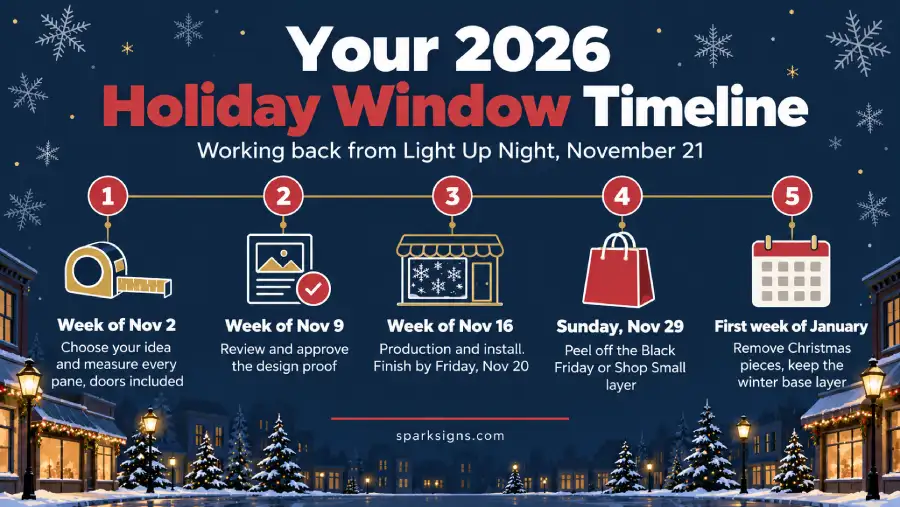
When a holiday window looks rushed, the design is rarely the problem. The calendar is. Here’s the schedule we’d plan around for a 2026 install:
- Week of November 2: Choose the idea, measure every pane (doors and transoms included), and gather logos, brand colors, and any offer copy.
- Week of November 9: Review the proof. One round of revisions is normal. Three rounds will push you past Light Up Night.
- Week of November 16: Production and installation. Aim to be finished by Friday, November 20.
- Sunday, November 29: Peel off any Black Friday or Small Business Saturday layer and leave the Christmas scene in place.
- First week of January: Remove the Christmas pieces and keep the winter base layer, if you planned one.
Reading this after the first week of November? Don’t skip the window. Simplify it. A one or two color cut-vinyl design moves through production faster than a full-color printed scene, and it still reads clearly from the curb. For the rest of the season’s key dates, from Veterans Day through New Year’s Eve, see our 2026/27 marketing calendar for Pittsburgh businesses.
10 Christmas Window Display Ideas for Shops and Restaurants
These are listed roughly from simplest to most involved. Most storefronts only need one or two of them, plus a couple of the practical pieces like holiday hours.
1. The One-Color Vinyl Scene
A single color, usually white, cut into a skyline, a line of evergreens, or a sweep of snowflakes across the full width of the glass. It’s the most cost-effective idea on this list and one of the best looking. White vinyl reads like frost against dark glass during the day and glows when the store lights are on behind it at night. It also leaves most of the window clear, so your products and the inside of your shop stay visible. A Pittsburgh skyline or the bridges along the rivers in white works especially well for businesses that want something local instead of generic Santa clip art.
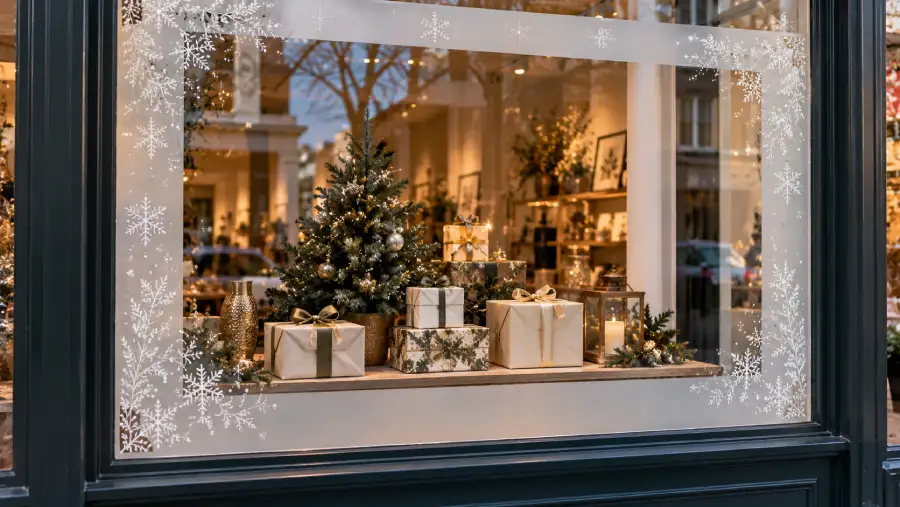
2. Frosted Border, Clear Center
Frosted vinyl is a translucent film that looks like etched or sandblasted glass. Run it around the edges of the pane and leave a clear opening in the middle, and it frames whatever sits behind it the way a mat frames a photo. An ordinary product shelf, a dining room, or a decorated tree suddenly becomes the focal point without anything being covered up. Add a short cut-vinyl message inside the frosted band, like your shop name and “Happy Holidays,” and the window carries both a seasonal look and your brand. Banks, offices, salons, and medical practices like this one because it’s festive without being loud.
3. A Countdown That Changes Through December
Regulars stop looking at a window once they’ve seen it. A countdown gives them a reason to check back. Numbered panels from 24 down to 1 can be static-cling pieces your staff peels off each morning, while the main scene stays put. Coffee shops, bakeries, and restaurants with daily regulars get the most from this, because the same people pass every day and start watching for the change. Tie each number to a small daily deal (“Day 12: free cookie with any coffee”) if you want to see whether anyone is paying attention.
4. Holiday Hours and Pickup Info Built Into the Design
Every December, someone tapes a printed sheet of holiday hours to the front door, and it ends up being the least attractive thing on the storefront. Fold that information into the window design instead. Early closing on Christmas Eve, gift card availability, curbside pickup, the last day to order for Christmas delivery: set it in the same vinyl and the same typeface as the rest of the scene. It looks intentional, and it answers the question customers would otherwise have to call and ask.
5. Restaurant Windows That Sell Catering and Reservations
Restaurants have a different job from shops in December. The money is in holiday party reservations, catering trays, and gift cards, and a lot of those are booked by people who walk or drive past. A window that says “Now booking holiday parties” with a QR code to your reservation page, or lists a clear catering deadline (“Order holiday trays by December 18”), does more work than a decorative scene alone. Keep the message to one line that can be read from a passing car, and put the details on the door pane where people stop. For an example of restaurant window work we’ve installed, see our Qdoba window graphics project.
6. Full-Scene Perforated Window Film (and Its Night Problem)
Perforated window film is a printed vinyl full of tiny holes that shows an image from the outside while still letting people inside see out. It’s the same one-way material you see on bus windows, and it lets you print a full-color holiday scene across an entire storefront. In daylight it’s dramatic.
Here’s what most idea lists leave out. Perforated film works because the outside is brighter than the inside. After dark, when your interior lights are on and the street is dim, that relationship flips: the printed image fades and passersby see straight through into the store. If most of your traffic comes after 5 p.m., use perforated film on the panes that matter during the day and choose opaque or cut-vinyl graphics for the ones that need to work at night.
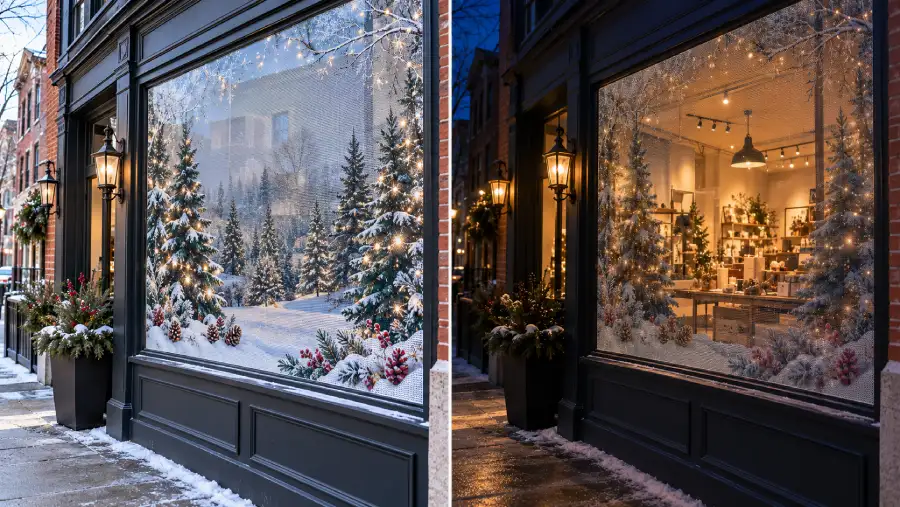
7. Lit From Behind for After-Dark Traffic
In December, a big part of your window’s audience sees it in the dark: commuters heading home, people walking to dinner, crowds headed to holiday events. Translucent backlit film placed in front of a light source glows instead of disappearing, and even simple white vinyl in front of warm interior lighting holds up well. Put those lights on a timer that runs a few hours past closing so the window keeps working after you lock the door. We go deeper on this in why some storefronts glow at night and why it matters.
8. Two-Sided Graphics for Corner Units and Glass Vestibules
Corner storefronts, glass vestibules, and windows facing a mall concourse or office lobby are seen from both directions. A single-sided graphic looks great from the street and like a backwards jumble from inside. Double-sided printed film, or two layers mounted back to back, gives customers in the store something to look at too. It’s the kind of detail shoppers notice while they’re waiting in line, and it costs less than most people expect when it’s planned from the start instead of added later.
9. A Shop-Small Layer for Small Business Saturday
Small Business Saturday falls on November 28, two days after Thanksgiving. A removable “Shop Small This Saturday” panel layered over your Christmas design gives that weekend its own message without a second full install. Peel it off on Sunday and the scene underneath is untouched. The same trick works for a Black Friday sale panel or a one-day event. This is where planning the layers ahead of time pays off: temporary pieces always go on top, never underneath.
10. Design for January While You’re Designing for December
The Christmas window usually comes down in a hurry in early January, and then the glass sits bare through the slowest weeks of the retail year. When you plan the holiday design, plan a winter base layer that stays: snowflakes, a frosted border, or a simple seasonal message in neutral colors. The Christmas-specific pieces (red and green accents, “Merry Christmas,” gift messaging) come off in the first week of January and the window still looks finished. One design session covers two seasons, and you skip the empty-glass look entirely.
Inside or Outside the Glass? What a Pittsburgh Winter Does to Window Graphics
Where the graphic sits on the glass matters as much as what it shows. Late fall and winter in Western Pennsylvania are hard on anything applied to the outside face of a window: cold glass, condensation, freezing rain, salt spray from plowed roads, and the occasional employee clearing frost with an ice scraper.
Whenever the design allows, we apply holiday graphics to the inside of the glass. The artwork is printed or cut in reverse so it reads correctly from the street, an approach installers call second-surface application. The graphic stays dry, it’s protected from scrapers and salt, and it’s easier to remove in January.
Exterior application still makes sense in some cases, for example heavily tinted or reflective glass that would hide an interior graphic. If that’s your storefront, install before the deep cold sets in. Vinyl adhesives have a minimum application temperature, and cold, damp glass is one of the most common reasons a window graphic starts lifting at the edges by mid-December.
Static cling is the third option. It uses no adhesive and can be repositioned, which makes it ideal for countdown numbers or a weekend-only panel. Over several weeks, though, it doesn’t hold large full-window graphics as reliably as adhesive vinyl, so keep it for the small pieces.
Christmas Window Mistakes We See Every Year
- Covering every inch of glass. A fully blocked window can make a store look closed, especially at night when no light comes through.
- Text too small to read from the curb. Anything a driver should catch needs large letters and very few words.
- Forgetting the door. It’s the pane every customer touches, and it’s the one most often left blank or covered in tape.
- Designing only for daylight. A window that disappears after 5 p.m. misses a big share of December foot traffic.
- Leaving it up until February. A Christmas window in mid-January tells people nobody is paying attention.
How Spark Signs Helps With Holiday Windows
Spark Signs designs, prints, and installs holiday window graphics for businesses across the Pittsburgh area, from a single front door to a full storefront. We measure the glass, build the proof around your brand colors, and plan the layers so the Christmas pieces come off cleanly in January while the winter base stays. Take a look at our custom storefront window graphics, our holiday sale banners for exterior visibility, and our holiday event graphics for in-store and event displays. If you want your window finished before Light Up Night, request a quote in the first week of November.
Frequently Asked Questions
Do Christmas window displays increase sales?
They can, mostly by bringing in people who would otherwise walk past. A window can’t close a sale on its own, but it often decides whether someone stops and comes through the door. The effect is easiest to measure when the window carries a specific offer, a QR code, or a code word customers mention at the register.
When should I put up my Christmas window display?
In Pittsburgh, aim to have it installed by the weekend before Thanksgiving, which in 2026 is Light Up Night on November 21. Most businesses keep the display up through New Year’s. Order the graphics by early November, since production and installation typically take two to four weeks.
How much does a Christmas window display cost?
It depends mainly on the glass area, the material, and whether the design is cut vinyl or full-color print. A one-color cut-vinyl design on a single pane sits at the low end, while full-coverage perforated film across a whole storefront costs more. The fastest way to get a real number is to send your window measurements and a photo of the storefront for a quote.
What should a store hang in its windows for Christmas?
Start with one clear idea that fits your brand, such as a winter scene, a frosted frame around your products, or a countdown. Then add the practical details customers need, like holiday hours and gift card availability. Finally, make sure the window works after dark, because much of December’s foot traffic passes after sunset.
Can holiday window graphics be removed without damaging the glass?
Yes. Removable vinyl and static cling are made to come off cleanly, and graphics applied to the inside of the glass are the easiest to remove. Any adhesive residue usually comes off with a plastic scraper and glass cleaner. Removal goes smoothest when it’s done in early January rather than after months in the sun.
How do I make my store window stand out at night?
Light it from behind or above, and choose materials that glow instead of disappearing. White cut vinyl in front of warm interior lighting and translucent backlit film both hold up well after dark. Put the lights on a timer so the window keeps working after closing time.
Pick One Idea and Book the Date
The best holiday windows aren’t the most elaborate ones. They’re the ones planned early enough to be finished on time, readable from the street, and still good-looking at 6 p.m. on a December weeknight. Pick the idea that fits your storefront, measure your glass this week, and work backward from November 21. If you’d like a second set of eyes on the design or help with the install, the Spark Signs team is glad to come take a look.