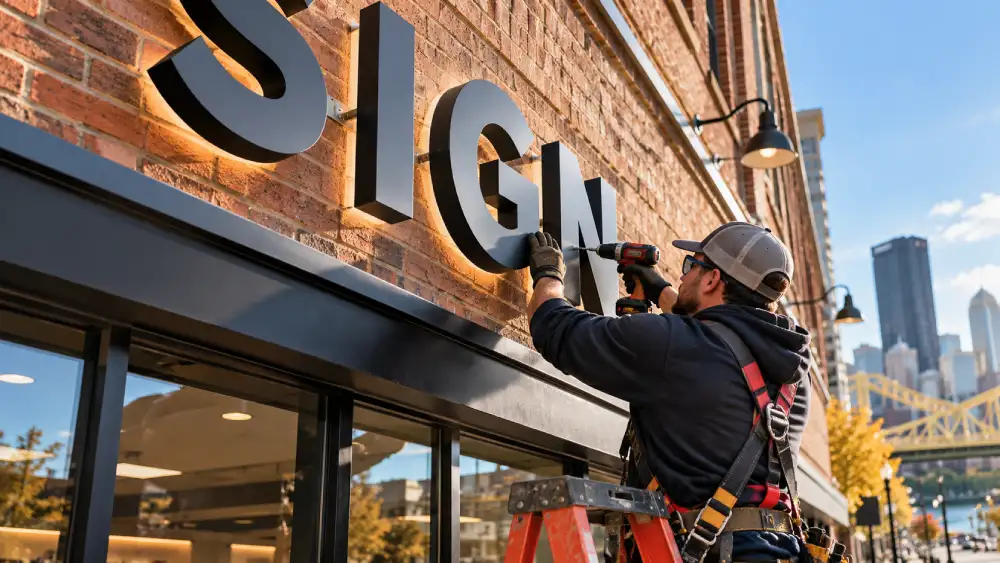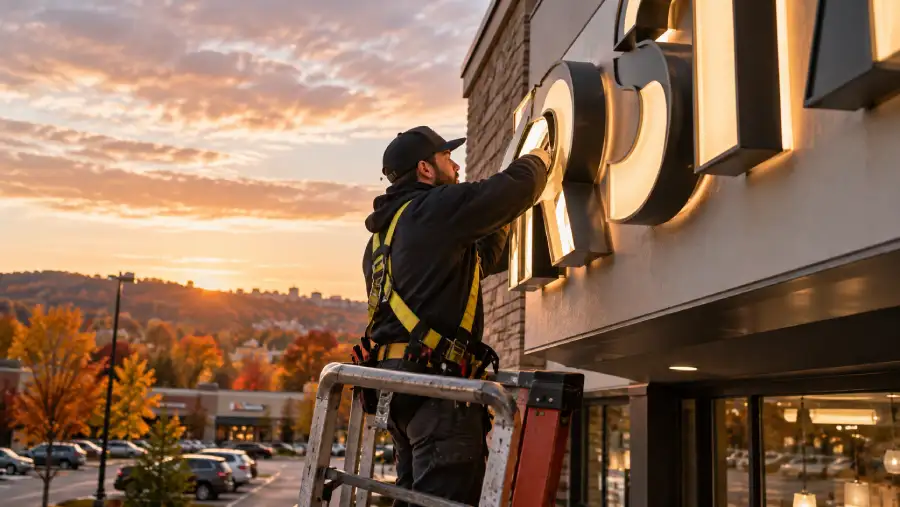
Most people who visit a church for the first time make up their minds before anyone shakes their hand. They decide from the road whether the building looks open and active, from the parking lot whether they can find the right door, and from the lobby whether they’ll have to ask a stranger where the restroom is. Church signs that attract visitors do one job at each of those moments: they answer the question a newcomer is too shy to ask out loud.
That’s a different job from the one your members need signs for. Members already know the service time, the side door, and where the nursery is. Guests know none of it. In our work fabricating church signage across the Pittsburgh area, the congregations that grow tend to treat signs as part of the welcome team, not as building identification. This guide follows the path a first-time visitor takes, from the street to the sanctuary, and covers what works at each stop.
Key takeaways
- Your roadside sign has a few seconds to tell drivers your name, that you’re active, and when to come. Service times beat slogans.
- Fewer churches staff the parking lot than a decade ago (18% in 2025, according to Lifeway Research), so signs now do much of the greeting.
- Inside, guests look for the restrooms, the kids’ area, and the sanctuary. Sign all of them from the front door.
- Churches are exempt from ADA Title III, but tactile room signs built to the ADA standard still help every visitor.
- Walk your own campus as a stranger once a year. You’ll spot the gaps faster than any consultant.
What Makes a Church Sign Attract Visitors?
Church signs that attract visitors are written for people who have never been inside. They show the church’s name and service times in letters large enough to read from a moving car, signal that the building is active this week, and guide a newcomer from the street to the parking lot, the entrance, the kids’ area, and the sanctuary without anyone having to ask for help. At every stop, clarity wins over cleverness.
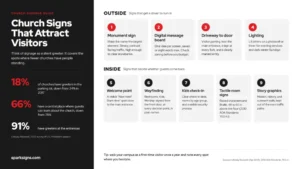
The idea that helps most churches is to think of signage as a silent greeter. In a 2025 survey of U.S. Protestant pastors, Lifeway Research found that 91% of churches have greeters at the entrances, but only 18% have greeters in the parking lot, down from 24% in 2017. The share of churches with a central place where guests can learn about the church fell from 78% to 66% over the same period. In other words, fewer people are standing at exactly the spots where newcomers feel most lost. Signs can cover those gaps every Sunday without adding a single volunteer shift.
Guests do notice. When Thom Rainer gathered first-time visitor stories for a 2017 Lifeway article, one of the good experiences he chose to highlight was simply: “The church was clean and had great signage.” It was an informal survey, but it matches what church facilities teams tell us. Nobody compliments the signs when they work, and everybody remembers when they don’t.
Outside the Building: Signs That Get a Driver to Turn In
Exterior church signs have one audience: someone driving past at 25 to 45 miles per hour who wasn’t planning to stop. Everything in this section is about making the decision to turn in an easy one.
1. A Monument Sign People Can Read From the Road
A monument sign is a low, ground-mounted sign built on a solid base of masonry, stone, or aluminum, usually placed near the property entrance. For most churches it’s the most important exterior sign, because it’s the one that introduces you to traffic.
A few decisions separate a monument sign that pulls visitors in from one that disappears into the shrubs. Make the church name the largest element, and resist crowding it with a denomination seal, the founding year, the pastor’s name, and a verse all at once. Turn the sign perpendicular to the road rather than parallel to it, so drivers can read it on approach instead of only as they pass. Use strong contrast: light letters on a dark field or the reverse, never mid-tone on mid-tone. And set it high enough to clear parked cars and the snowbank a plow leaves along the curb by January, which is a real issue on Western Pennsylvania roads.
Size is the question we hear most. Letter height has to scale with how far away the reader is and how fast they’re moving, and setbacks on church properties are often deeper than people expect. A good sign shop will measure the distance from the travel lane and size the letters to it instead of picking from a catalog. If you’re comparing materials and lighting, our monument signs page shows the builds we do most often.
2. A Digital Message Board, Used With Discipline
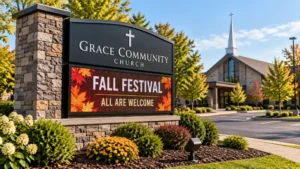
An electronic message center (EMC) is a programmable LED display that lets a church change its message remotely. Used well, it proves the congregation is alive this week: a fall festival, a grief support group, the Christmas Eve service time. Used badly, it scrolls six lines of small text that nobody can finish before the light changes.
Our rule for church boards is one idea per screen and no more than seven or eight words. Rotate a short loop of messages instead of cramming everything onto one slide. The messages that pull in visitors are specific and low pressure, like “Trunk or Treat Oct 31, 5 PM, all welcome” or “New here? Coffee and kids’ ministry every Sunday at 10.” A pun now and then is fine. A board that only runs puns starts to read like a joke account.
Check zoning before you budget for one. Many municipalities treat churches as conditional uses in residential districts, and electronic signs often face their own limits on brightness, how often the message can change, and distance from homes. We’ve taken church signs through zoning hearings in Cranberry Township and Ross Township, and those boards want to see brightness controls and message hold times before they approve anything. Our guide to how sign permits work in Pennsylvania explains why these projects stall and how to keep yours moving.
3. Directional Signs From the Driveway to the Door
Here’s a pattern we see on a lot of older church campuses. The building has five doors, members all use the side entrance by the lot, and the main doors facing the street stay locked on Sunday. A visitor parks, walks to the most obvious entrance, and finds it locked. That’s a rough first minute, and some people simply get back in the car.
Three signs fix most of it. A visitor parking sign near the main entrance tells guests you planned for them. A directional sign at every fork in the drive or the lot points to the “Main Entrance” or “Worship Entrance,” using the same name every time. And a clearly marked entry, ideally with a canopy sign or door graphic showing the church name or a simple “Welcome,” confirms they found the right place. If your accessible entrance is different from the main one, sign it from the parking lot, not just at the door.
4. Lighting for Evening Services and Dark Winter Sundays
Plenty of church life happens after dark: Wednesday night programs, youth group, Ash Wednesday, Christmas Eve, and any 5 p.m. service from November through February. An unlit sign effectively vanishes for those visitors. Internally lit or halo-lit letters, or a monument sign with ground-mounted lights, keep your name readable at night, and a photocell or timer means nobody has to remember to flip a switch. We wrote more about this in our post on business visibility at night, and the same physics applies to a church on a dark two-lane road.
Inside the Building: Signs That Decide Whether Guests Come Back
Getting someone through the door is half the work. Inside is where a newcomer decides whether they felt welcome or felt like they’d wandered into someone else’s family reunion. Interior signage carries more of that feeling than most church leaders realize.
5. A Welcome Wall or Guest Services Point
Guests need somewhere to go when they don’t know where to go. A clearly signed welcome or guest services area, close to the main entrance and visible the moment someone walks in, gives them that. It doesn’t need to be elaborate. A dimensional logo on the wall, a “New Here? Start Here” sign above a counter, and a rack of info cards is often enough. Lifeway’s numbers show fewer churches keeping a central information point than in 2017, which is exactly why a visible one stands out.
6. Wayfinding to the Three Places Every Guest Looks For
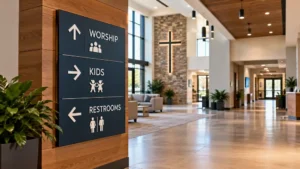
In our experience, first-time visitors hunt for the same three things within a few minutes of arriving: the restrooms, the children’s area, and the sanctuary. If your lobby signs answer those three questions from the front door, most guests will never need to stop and ask.
Good church wayfinding follows the same rules as any building. Put a directional sign at every decision point, where a hallway splits or a stairway starts. Use names a stranger understands (“Worship,” “Kids,” “Restrooms”) instead of the ones members use (“the Fellowship Hall,” “the Annex,” “Room 12”). Keep fonts, colors, and arrow styles consistent so people learn the system once. Our post on why people get lost inside buildings walks through the decision-point method in detail, and it works the same in a church as in an office park. For larger campuses, a wayfinding sign package planned all at once usually costs less than adding signs one complaint at a time.
7. Children’s Check-In and Classroom Signs
Parents are the visitors most likely to come back if the morning goes well, and the most likely to leave for good if it feels disorganized. Clear signs for the kids’ check-in desk, room signs labeled by age group, and a visible note about your security process (name tags, pickup rules) reassure a parent before they hand a toddler to people they met two minutes ago. Bright colors work well in a children’s wing, as long as the room names stay readable from down the hall.
8. Tactile Room Signs, Even If You’re Not Required to Have Them
This one surprises a lot of church boards: religious organizations are exempt from Title III of the Americans with Disabilities Act, the section that governs signage in most buildings open to the public. The U.S. Department of Justice says so directly in its ADA Title III Technical Assistance Manual, and the exemption covers places of worship. Local building codes can still apply, especially during new construction or renovation, so check with your municipality before you assume you’re clear.
Exempt doesn’t mean tactile signs are a waste. A visitor with low vision, an older member, or a guest using a wheelchair all benefit from room signs built to the standard: raised characters with Braille, mounted so the baseline of the lowest tactile character sits at least 48 inches above the floor and the highest no more than 60 inches, per section 703.4.1 of the 2010 ADA Standards. Building to that spec adds very little cost when the signs are being made anyway. Our ADA compliance basics post covers the rest of the requirements.
9. Lobby and Sanctuary Graphics That Show Who You Are
Once wayfinding is handled, interior graphics can do the warmer work. A lobby wall with your mission statement, a timeline of the congregation’s history, photos from outreach events, or a donor recognition wall tells a visitor what this church cares about before a single conversation. Keep these out of the main traffic paths so they don’t compete with directional signs. People read a mission wall while they’re waiting, not while they’re trying to find the nursery.
The First-Visit Walk Test: A 20-Minute Signage Audit
The cheapest signage improvement is noticing what’s missing. Once a year, ask someone who has never been to your church (a friend from another congregation, a neighbor, a staff member’s cousin) to arrive on a Sunday and say out loud what they see and what confuses them. Or do it yourself with fresh eyes. Here’s the route we suggest:
- Drive past at normal speed from both directions. Could you read the church name and the service time? Did you know where to turn?
- Pull into the lot. Is there visitor parking, and is it near the entrance you want guests to use?
- Walk to the door. Is the right entrance obvious? Is the accessible entrance signed from the lot?
- Step inside and stop. Without moving, can you tell where the restrooms, the kids’ area, and the sanctuary are?
- Find kids’ check-in the way a parent would. Was it clear where to start and how the security process works?
- Leave after the service. Is there a clear exit, a sign inviting guests back, and an easy way to find your website?
Write down every spot where your tester hesitated or had to ask someone. That list is your signage plan, and the spots near the beginning of the route matter most because they’ve been costing you visitors before anyone inside ever met them. If you hold evening services, repeat the walk after dark.
What to Put on a Church Sign (and What to Leave Off)
Most lists of church sign ideas focus on clever phrases. Clever is fine, but it’s the least important part. For a newcomer, the messages that work are the ones that answer a practical question or offer a low-commitment way in.
Lead with your name and service times. Promote specific events with a date, a time, and “all welcome.” Mention what parents care about, like kids’ ministry or a family night. Lean on seasons when people are already thinking about church: Easter, Christmas Eve, back-to-school. Leave off insider language that only members understand, long scripture references that need a second look, and anything that reads like a lecture aimed at the people driving by. If a message wouldn’t make sense to someone who has never stepped inside, it isn’t written for visitors.
Frequently Asked Questions
What should a church sign say to attract visitors?
Your church name, your main service time, and one specific reason to visit, such as an upcoming event or a note that kids’ ministry is available. Keep each panel or screen to one idea and a handful of words. Welcoming, practical messages work better for newcomers than slogans or inside jokes.
How can I make my church sign more effective?
Make it readable from a moving car: strong contrast, letters sized to the distance from the road, and a position that faces oncoming traffic. Light it for evening and winter hours, and change the message often enough that it looks current. Then make sure your parking lot and entrance signs finish the job the roadside sign started.
Do churches need a permit for an electronic sign?
In most places, yes. Nearly every municipality requires a sign permit, and electronic message boards often face extra limits on brightness, message hold time, and distance from homes. Churches in residential districts may also need a zoning hearing, so check local code before buying hardware.
How often should a church change its sign message?
Weekly is a good baseline for a changeable letter or digital sign, with event messages going up two to three weeks ahead. A sign that shows the same message for months starts to look unattended. On a digital board, rotate a short loop of a few messages instead of packing everything into one.
What are the signs outside of churches called?
The main roadside sign is usually a monument sign, a low, ground-mounted sign on a solid base. Many include a changeable letter panel or an electronic message center (EMC) for service times and events. Smaller signs along the drive and in the lot are called directional or wayfinding signs.
Do churches have to follow ADA signage rules?
Religious organizations are exempt from Title III of the ADA, according to the Department of Justice’s Title III Technical Assistance Manual. Local building codes may still require accessible signage, particularly during new construction or renovation. Many churches build tactile room signs to the ADA standard anyway because it helps every visitor.
Start With the Sign Your Visitors See First
If you can only fix one thing this year, fix the sign a stranger sees first, which for most churches is the one by the road. Then walk the path to the sanctuary and fix the next spot where someone would hesitate. Signs won’t replace a warm greeter or a good sermon, but they decide whether a newcomer ever reaches either one.
Spark Signs & Graphics designs, permits, and installs church signage across Pittsburgh and Western Pennsylvania, from monument signs and digital boards to lobby graphics and full wayfinding packages. If you’d like a second set of eyes on your campus, we’re glad to walk it with you. And for more practical guides on wayfinding, permits, and seasonal signage, browse the rest of the Spark Signs blog.