Meeting ADA compliance requirements for businesses is not a one-time checklist item, it’s an ongoing legal obligation that affects everything from your parking lot to your restroom door. Business owners who assume their space is compliant because it “looks fine” are often missing the specific signage, tactile, and placement standards the Americans with Disabilities Act actually requires. This guide breaks down what compliance really means, where businesses most often fall short, and how the right signage protects both your customers and your business.
What ADA Compliance Actually Requires From Your Signage
ADA compliance, meeting the accessibility standards set by the Americans with Disabilities Act for the built environment. For signage specifically, this means precise rules around character height, contrast, tactile lettering, Braille, mounting height, and placement relative to doors. These aren’t suggestions. The Department of Justice’s 2010 ADA Standards for Accessible Design spell out exact measurements, and local building inspectors check them during occupancy and renovation inspections.
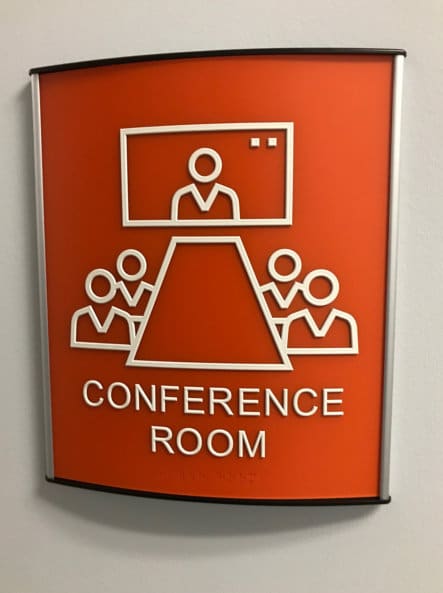
Every permanent room, restrooms, exits, stairwells, and any room that isn’t likely to change function, needs signage that meets these standards. Temporary or changeable signage, like a directory listing that gets updated seasonally, follows a different, slightly more flexible set of rules. Knowing which category each sign in your building falls into is the first step toward real compliance, not just the appearance of it.
The Most Common ADA Signage Mistakes We See
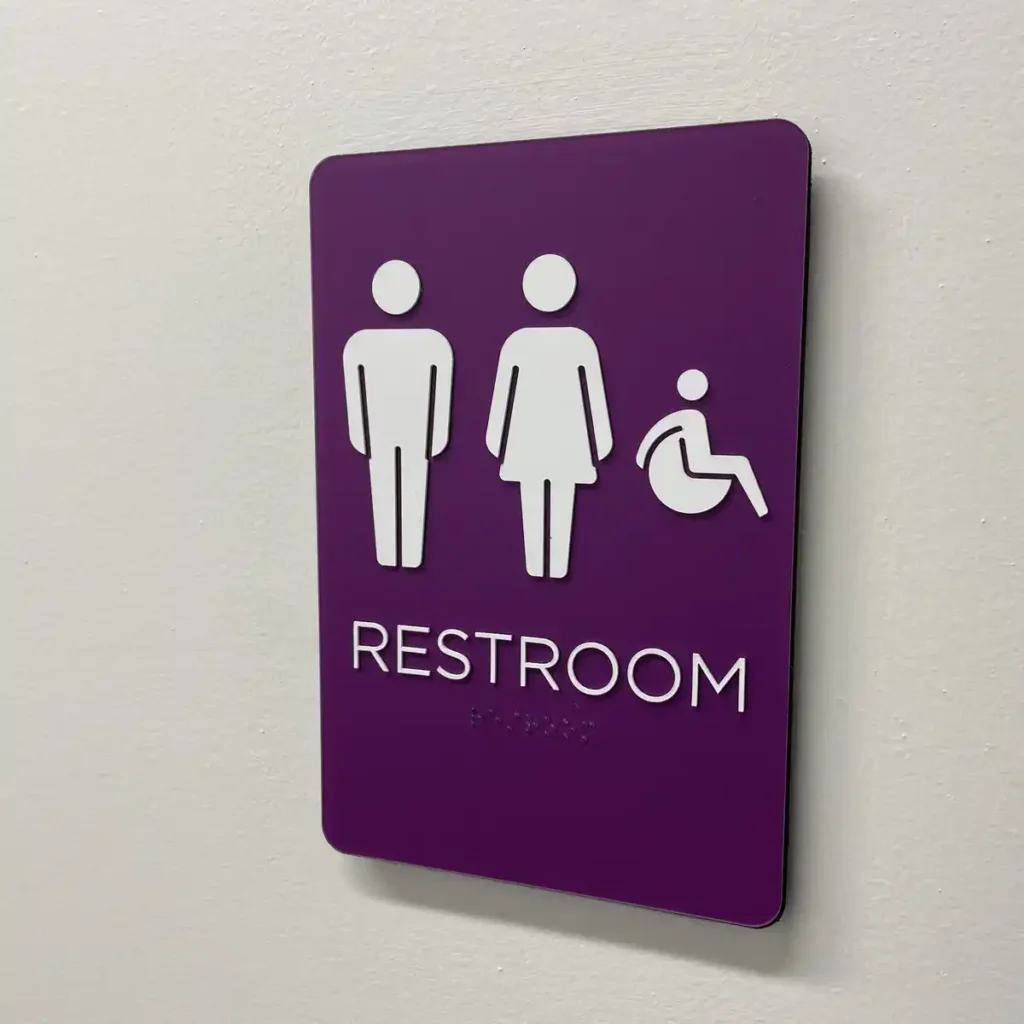
In our work with commercial clients across the Pittsburgh area, the same handful of mistakes show up again and again. Restroom signs mounted at the wrong height, ADA requires the sign centered 48 to 60 inches above the floor, are the single most common violation we find during site walks.
- Braille dots that are decorative rather than Grade 2 Braille, which does not meet code
- Insufficient contrast between text and background, which fails the 70% light-reflectance standard
- Signs mounted on the door itself instead of the adjacent wall, where they become unreadable when the door opens
- Character height that’s too small for the sign’s mounting distance from the viewer
- Missing tactile exit signage in stairwells, a violation inspectors flag consistently
Each of these seems minor in isolation, but any one of them can trigger a failed inspection, a delayed occupancy permit, or (increasingly) an ADA compliance lawsuit. Serial ADA litigation has grown steadily across commercial real estate nationally, and signage is one of the easiest violations for a plaintiff’s inspector to document.
Interior vs. Exterior ADA Signage: Different Rules, Same Standard
Exterior signage, building identification, accessible parking, and entrance signs, falls under ADA standards too, but the requirements shift depending on whether the sign is informational or wayfinding. Accessible parking signs, for example, need the International Symbol of Accessibility, correct mounting height, and in many municipalities, a van-accessible designation for a percentage of spaces.
Interior wayfinding is where we see the widest range of compliance gaps, because directory signage often gets updated informally a new tenant moves in, and a sign gets swapped without anyone checking it against current code. A properly designed directories and wayfinding system builds ADA compliance into the format from the start, so updates don’t quietly break compliance later. See our approach to directory and wayfinding signage for how we handle multi-tenant and healthcare facilities where this matters most.
How Professional Sign Companies Keep You Compliant
A sign shop that understands ADA compliance requirements for businesses does more than print and mount, they verify character proportions, contrast ratios, Braille grade, and mounting height against the current code before a single sign goes on the wall. We’ve seen clients who ordered ADA signage online, discovered during inspection that the mounting height was off by two inches, and had to pull the signs and reorder a delay that pushed back their occupancy date by weeks.
Authoritativeness, a properly documented ADA signage package includes a placement plan an inspector can review at a glance, not just the signs themselves. That documentation is often the difference between a passed inspection and a call-back.
If you’re opening a new location, renovating, or simply unsure whether your current signage would pass inspection today, our ADA signage services start with a walkthrough of exactly what your space needs, no guesswork, no generic templates.
Frequently Asked Questions
What are the ADA compliance requirements for businesses when it comes to signage?
ADA compliance requirements for businesses cover character height, contrast, tactile and Braille lettering, and mounting height for every permanent room sign. The 2010 ADA Standards for Accessible Design set the exact measurements, and most local building codes enforce them at inspection.
Do all business signs need to be ADA compliant?
No, only permanent room signs, exit and stairwell signage, and accessible parking signage are required to meet the full ADA standard. Changeable directory signage follows more flexible rules, though it still has baseline requirements.
How high should an ADA restroom sign be mounted?
ADA restroom signs must be centered between 48 and 60 inches above the finished floor, mounted on the wall adjacent to the door rather than on the door itself, so the sign stays readable when the door is open.
What happens if my business signage isn’t ADA compliant?
Non-compliant signage can delay an occupancy permit, fail a building inspection, and expose a business to ADA litigation, which has increased steadily across commercial properties in recent years.
Can I install ADA signage myself, or do I need a professional sign company?
You can install ADA signage yourself, but the risk is in the details; Braille grade, contrast ratio, and mounting height are easy to get wrong without a compliance checklist. A professional sign company verifies each of these before installation, which avoids the cost of reordering non-compliant signs.