The most effective pop up shop ideas for small business owners are not the flashiest. They are the ones matched to a specific goal (sell through inventory, test a new city, collect emails, launch a product) and backed by signage a stranger can read from across a parking lot. Everything else is decoration.
Seasonal markets make that clarity harder to hold onto. You are one of forty vendors under a tent, and the shopper walking toward you decides in about two seconds whether to slow down. This playbook covers what to sell, what it costs, and the part most guides skip: how your booth actually reads from a distance.
What Counts as a Pop Up Shop (and How Seasonal Markets Differ)
A pop up shop is a temporary retail space, open from a single weekend to a few months, used to sell directly to customers without a long lease. A seasonal market is a version of that: a shared, organized event (a holiday village, a craft fair, a summer night market) where you rent a booth alongside other vendors.
The difference matters more than it sounds. In a standalone pop up you control the space, but the foot traffic is yours to earn. In a seasonal market the organizer brings the crowd, and you compete for attention inside a wall of other tents. One is a real estate problem. The other is a visibility problem.
Most small businesses should start with seasonal markets. Entry costs are lower, the commitment is a weekend instead of a quarter, and you get an honest read on whether people will pay your prices in person.
7 Pop Up Shop Ideas for Small Business Owners
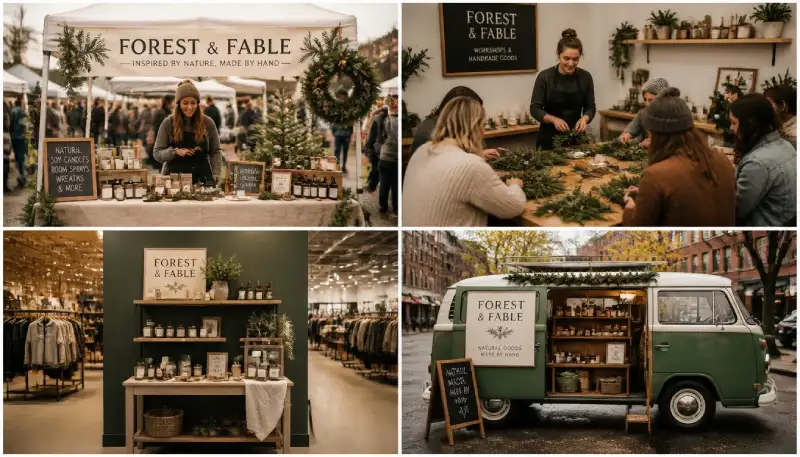
Each answers a different question. Choose based on what you need to learn or earn.
1. The holiday market booth
Still the highest-converting option for most product businesses, because shoppers arrive intending to buy gifts. Bring a tight assortment (six to ten SKUs beats thirty), price at round numbers, and gift-wrap on the spot.
2. The collaboration pop up
Share a space with a complementary business: a coffee roaster with a ceramicist, a skincare line with a florist. You split the rent, and more usefully you split the audience. Each of you brings customers the other has never reached.
3. The workshop pop up
Charge for a class instead of hoping for browsers. Wreath-making in November, terrarium building in spring. Attendees pay to be there, so you have revenue before you open, and people who make something buy the supplies to keep going.
4. Store within a store
Rent a corner inside an established retailer that already has the traffic you want. It is the cheapest way to test a new neighborhood. Bring your own display and signage so the corner reads as yours, not as their clearance rack.
5. The mobile pop up
A converted van, trailer, or cargo bike that moves between neighborhoods and events. Higher upfront cost, but the vehicle advertises for you between stops and you pay rent nowhere.
6. The launch and sampling pop up
Built for a single product introduction. Everything in the space points at one item, samples are free, and the goal is trial plus a sign-up rather than a big sales day. Food and beauty brands use this to gather real reactions before a wider rollout.
7. The sample sale or overstock pop up
Turn dead inventory into cash and email addresses. Clear signage on the discount, a hard end date, and one price tier per table keeps the line moving. Best in January and late summer, when shoppers hunt markdowns.
The 30-Foot Rule: Why Most Booths Lose Sales Before Anyone Walks Up
Here is the pattern we see over and over. A vendor invests months in product, then communicates who they are with a chalkboard sign propped on a chair. From thirty feet away that booth says nothing, and the shopper’s eye slides past it to the tent with a five-foot banner.
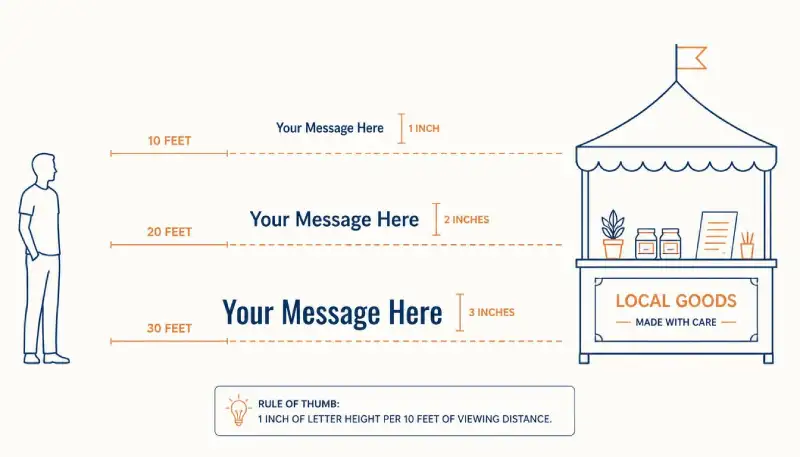
Stand thirty feet back from your own setup and read it. If a stranger cannot tell what you sell in under two seconds, the setup has failed, regardless of how good the products are. Text needs to be roughly one inch tall per ten feet of viewing distance, so a sign read across an aisle needs three-inch letters at minimum.
Three fixes handle most of it. First, one large, high-contrast banner sign with your business name and a plain product category (“Handmade Leather Bags” beats a clever tagline nobody can decode at speed). Second, vertical height: retractable banners and flags rise above the tent line where everything else sits at eye level. Third, undated messaging. A banner reading “Holiday Market 2026” is trash in January; the same banner without the date works for years.
That last point saves real money. Small businesses often treat event graphics as disposable, then re-buy them every season. Building a reusable kit (a main banner, one retractable, a table throw, a price board) converts a recurring expense into a fixed asset. Professionally produced tradeshow and special event displays are built for exactly this repeat use, with hardware that packs down and survives being loaded into a car forty times.
What a Pop Up Actually Costs, and How Long to Plan
Costs vary by format, but the entry point is lower than most people assume. Square’s pop up retail research found 44% of surveyed retailers spent less than $5,000 on their space. Seasonal market booths sit far below that: many community and holiday markets charge $50 to $500 for a weekend, sometimes plus a small cut of sales.
Beyond the space, budget for a payment system that works without reliable wifi, a canopy and weights if you are outdoors, lighting for evening markets, packaging, and the signage kit above. Signage is the most underestimated line and the one with the longest useful life.
Popular holiday markets fill their vendor lists in late summer. Apply eight to twelve weeks out for seasonal events, four to six for a standalone space, and order printed materials three weeks before the date so you are not paying rush fees.
Measure It Like a Channel, Not a Party
A pop up that breaks even but adds 300 engaged email subscribers can beat one that sells out and captures nothing. Track four numbers: gross sales, cost per acquired customer, email or SMS sign-ups, and repeat purchase rate from those contacts over the next ninety days.
The ninety-day number tells you whether to book the same market next year. Shopify’s retail research points to in-store shopping still being the preferred channel for a large share of buyers, which is why follow-up matters: the relationship starts at the booth, but most of the revenue arrives later.
Frequently Asked Questions
Do you need a license to open a pop up shop?
In most cases, yes. You typically need a general business license and a sales tax or seller’s permit for the state you are selling in, and many cities require a temporary vendor permit for events. Organized markets usually handle venue permits but will ask for proof of your license and liability insurance.
How much does it cost to open a pop up shop?
A weekend booth at a seasonal market commonly runs $50 to $500 in space fees; a standalone short-term retail space costs much more. Square reports 44% of surveyed retailers spent under $5,000 on their pop up space. Add inventory, a payment reader, a canopy, and signage on top.
What sells best at seasonal markets?
Giftable items under $50 with obvious visual appeal sell best, because most seasonal market shoppers are buying for someone else and deciding fast. Food, candles, jewelry, prints, and personalized goods perform consistently. Bring fewer SKUs than you think you need.
What signage do you need for a pop up shop?
At minimum: one large banner with your business name and product category readable from thirty feet, a table cover, and clear pricing. Add a retractable banner for vertical height and a QR code sign near the register. Keep dates off the artwork so the kit works all year.
Are pop up shops still worth it for small businesses?
Yes, when the goal is defined before you book. Pop ups remain one of the few low-commitment ways to test a product, a price point, or a new market with real customers in front of you.