Glass walls made the modern office feel bigger and brighter, and they also mean a hard conversation in a conference room is visible to everyone walking past. Office privacy for glass walls comes down to two decisions: how much privacy is actually needed, and whether that privacy has to come at the cost of the natural light the glass was installed for in the first place. Decorative and frosted window film solve both problems at once, without the expense or disruption of replacing the glass itself
Full Privacy vs. Partial Privacy
Frosted Film for Complete Visual Privacy
Frosted privacy film gives a room the etched-glass look at a fraction of the cost of actual etched or sandblasted glass, and it blocks visibility completely while still passing light through. This is the right call for conference rooms handling confidential material, HR offices, and any space where full visual privacy is a requirement rather than a preference.
Decorative and Gradient Film for Partial Privacy
Gradient film, clear at the top, frosted toward the bottom, lets a room keep its open, glass-walled feel from a standing height while still blocking sightlines at desk height. Patterned or dotted film does something similar and adds a design element rather than reading as purely functional. In our experience, this is the more common choice for general office glass, since most spaces want some visual break without fully closing the room off.
Patterned Film as a Middle Ground
Patterned film sits between the two options, breaking up a sightline with a repeating dot, line, or geometric motif rather than fully frosting the glass. It reads as more decorative than functional at first glance, which makes it a common choice for spaces that want a privacy treatment without the room feeling closed off, such as a shared conference room used for both internal meetings and casual collaboration.
Where Privacy Film Solves a Real Problem
Conference Rooms and Meeting Spaces
A glass-walled conference room with no privacy treatment means every whiteboard, every presentation, and every difficult conversation is visible to the entire floor. Frosted or gradient film on the lower half of the glass resolves this without sacrificing the room’s light or its sense of openness from the hallway.
Executive and HR Offices
Interior windows and privacy film give leadership and HR offices the confidentiality those roles genuinely require, while keeping the office from reading as closed-off or separate from the rest of the floor, a balance that fully solid walls can’t offer.
Reception and Client-Facing Areas
Reception areas and client-facing offices face a different version of the same problem: too much visibility into internal operations, staff work areas, or in-progress projects that aren’t meant for a waiting client to see. A lighter gradient or patterned film along a reception glass wall maintains an open, welcoming feel while keeping the day-to-day operational view appropriately screened.
Privacy Film as a Branding Surface
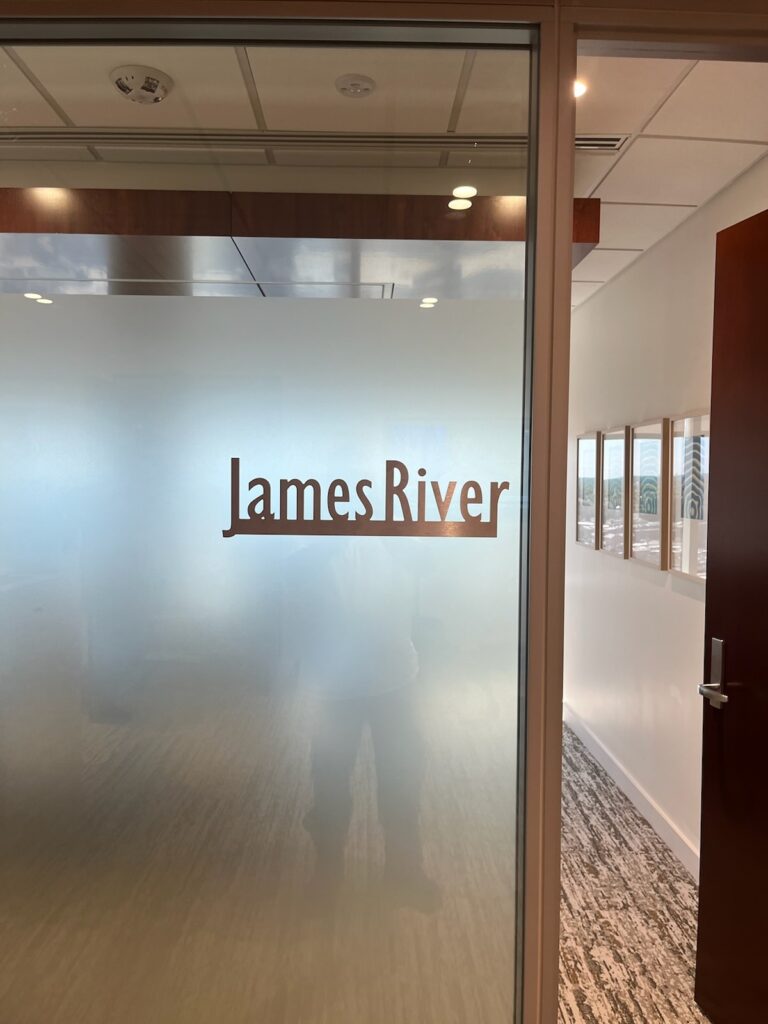
A glass wall is also blank real estate. Branded interior graphics, a logo etched into a frosted panel, a company tagline in a gradient band, or a full wall graphic on an adjacent solid surface, turn a privacy fix into a design statement instead of a purely functional add-on. This is a common request once a company sees the first frosted panel installed and realizes the same glass can carry the brand as well as the privacy.
The same design conversation often extends past the glass itself. Once a company sees a frosted panel carrying a logo, the natural next question is whether that same branding treatment can continue onto an adjacent solid wall, which is where interior wall graphics pick up where the glass leaves off.
What Glass Film Doesn’t Solve
Privacy film addresses visual privacy only. Sound still travels through glass and through the gaps around it, so a fully confidential conversation in a glass-walled room needs acoustic treatment, door seals, sound-dampening panels, or white noise, in addition to, not instead of, visual privacy film. Being upfront about this distinction is part of setting the right expectation before a project starts.
When acoustic privacy is the actual requirement, film still has a role to play as part of a combined approach: pairing frosted or patterned film with door seals and sound-dampening panels lets a room look and function like a fully private space, even though the film itself is only doing half the job. Being clear about that division up front avoids a project that solves the visual problem but leaves the original complaint, a conversation overheard through the wall, unresolved.
Choosing the Right Approach for Your Space
- Full privacy needed (HR, legal, confidential meetings): frosted film, full panel coverage
- Partial privacy, keep the open feel: gradient or dotted pattern film, lower-half coverage
- Branding opportunity: combine frosted or gradient film with a logo or wordmark element
- Sound-sensitive spaces: pair film with acoustic treatment, not as a substitute
What Installation Actually Involves
Privacy film installs directly onto existing glass, with no construction, drywall, or permitting involved, which is the detail that usually decides whether a company fixes the problem this quarter or defers it to a future renovation. A typical conference room or single office installation is completed in a matter of hours, with minimal disruption to the surrounding workspace, and most projects can be scheduled after hours or over a weekend for offices that don’t want visible work happening during business hours.
Because film is a surface treatment rather than a structural change, it’s also one of the few office upgrades that doesn’t require coordinating with a landlord or building management beyond a basic installation notice, which matters in multi-tenant buildings where larger renovations often require approval.
A Practical Approach for Pittsburgh Offices
Spark Signs has installed privacy film and branded interior graphics for law firms, medical offices, and corporate tenants across Pittsburgh, and the recurring pattern we see is a conference room that was designed years ago without privacy in mind, now retrofitted after a specific incident made the gap obvious, a confidential conversation overheard from the hallway, or a whiteboard visible to a competitor touring the building next door.
Retrofitting is straightforward for exactly the reason described above: film installs directly onto existing glass without construction or downtime, which is usually the deciding factor for offices that need the fix now rather than waiting for a future renovation cycle. For Pittsburgh’s older office buildings in particular, where glass partitions were often added during a later renovation rather than the original build, film is frequently the only practical option that doesn’t involve reworking the partition itself.
Frequently Asked Questions – Glass Office Privacy
What is the best way to add privacy to a glass office wall?
Frosted privacy film is the most direct solution for full visual privacy on a glass wall — it blocks sightlines completely while still allowing light through, without the cost of replacing the glass.
Can I have privacy without losing natural light?
Yes. Frosted and gradient window film both allow light to pass through while blocking or reducing visibility, which is the core reason these products exist instead of simply installing solid walls.
Does privacy film block sound as well as sight?
No. Privacy film is a visual solution only. Sound still passes through glass and surrounding gaps, so acoustic privacy requires separate treatment like door seals or sound-dampening measures.
What is gradient film and when should I use it?
Gradient film is clear at the top and frosted toward the bottom, giving a room partial privacy at desk height while keeping the open, glass-walled feel above eye level. It’s a common choice for general office space that wants a design touch, not full enclosure.
Can privacy film include our company logo or branding?
Yes. Frosted or gradient film can be combined with an etched or printed logo, tagline, or brand pattern, turning a functional privacy fix into a branded design element.
Is privacy film a permanent installation?
Privacy film is a removable, non-permanent installation, which makes it a lower-cost and lower-disruption option compared to replacing glass or building solid walls, and it can be updated or removed if office needs change.